

One year has passed since the outbreak of mass violence in Syria’s coast. What began as a coordinated, widespread insurgency by members of the Alawi sect devolved into days of mass killings, looting, and displacement by pro-government Sunnis targeting dozens of Alawi communities across Tartous, Latakia, and Hama. From March 6 to March 10, around 1,400 people were killed, mostly Alawi civilians, along with 238 government fighters. These events have been covered extensively by news outlets and through several human rights investigations. Most notable are the investigations published by the Syrian Center for Media and Freedom of Expression and the United Nations Commission of Inquiry. Both of these investigations provide essential information about the brutal events of the massacres, but cover only some aspects of the insurgent activity that preceded them.1 This report serves as an additional resource, examining several key aspects of how and why the violence in March unfolded the way it did by starting from the insurgency itself.
The SCM and COI reports provide excellent contextual background on the rising tensions and violence prior to March 6, as well as some aspects of the insurgent attacks that triggered the mass Sunni mobilization, and both should be read in full. However, they lack a broader examination of the insurgent networks pre-March 6 or the role of local Alawis in protecting security forces and their own towns, all of which has become clearer with the passage of time. A more holistic look at the origins and patterns of violence underscores the strength of ex-regime insurgent networks prior to March 6, the role of social media in mobilizing Alawi youth and fueling retaliatory violence, and the fragility of post-war peace even in places where security officials and Alawi leaders do everything right to prevent violence.
The events of March 2025 were neither just an insurgency nor just a massacre, as many have tried to frame it. The motivations behind the insurgency are just as varied as those that drove the subsequent mass killings, neither of which can be reduced simply to Alawi fear of the government or Sunni sectarianism against Alawis. The actions of both the Alawi community and of the pro-government fighters are similarly varied and should not be viewed as one-dimensional, with members from both sides actively working to prevent violence in the days leading up to and through the March massacres. Understanding the roots of this violence and the dynamics that fueled or limited it is crucial for understanding the coast’s trajectory since March 2025.
A Typology of Violence
The following report is based on months of field work in the coast, both in the weeks prior to March 6 and the year since, speaking with dozens of security officials, eyewitnesses, and local activists. This is not an investigation into the violations and crimes committed by armed civilians and government forces, although they are mentioned where possible. These have been covered extensively in the aforementioned reports. Instead, it examines the competing narratives within the Alawi community that underpinned support for the insurgency, how the insurgency unfolded across the coast, and 10 case studies examining patterns of violence or non-violence between March 6 and March 10. Understanding these foundations of the March violence is critical for developing effective policies to address the ongoing fragility of Damascus’ integration of Alawi communities into the new state.
The case studies reveal one important dynamic of the initial insurgent attacks: localities where many government forces were killed on March 6 and 7 are also where many of the largest anti-Alawi killings subsequently took place. Places where security forces survived generally saw far fewer violations. While members of the Interior Ministry’s General Security Service (GSS) also took part in anti-Alawi violations, the GSS broadly speaking, and especially local GSS officials, appear to have played a central role in limiting these killings in areas where they survived the initial insurgent attacks. This is important of course not because it justifies the violence that occurred, but rather because it speaks to the range of motivations of pro-government forces and the complex relationship between local Alawis and the GSS. While the GSS contributed to the massacres in some areas, they acted as barriers against the violence in others. This relationship has grown in the year since, with the GSS becoming the pillar of state engagement with rural Alawi communities, which many now view as the only trustworthy entity within the new Syrian government.
A rough typology of violence can be found in the following case studies, though again there is no singular pattern to the violence in March and some pro-government forces were certainly driven by purely sectarian motivations. Nonetheless, these the case studies, as well as the COI investigation, suggests three broad categories of violence with more multi-layered factors:
Targeted indiscriminate killings: One of the most unaddressed questions after March 2025 was why some Alawi communities were attacked and others were not. Most of the communities with the most significant Alawi massacres were also the sites of the largest insurgent attacks. These includes Sanobar2, Mukhtariyah3, Jableh4, Da’atour5, Resafa6, and Baniyas7. There is a clear pattern of pro-government forces specifically targeting villages from which significant insurgent movements arose, but once inside those villages killing any Alawi male, and at times women and children, that they encountered. Yet, most of these reprisal killings came after insurgents had already fled the area, leaving behind only civilians.
Survival of GSS on March 6 and 7 prevented wider violence: Some of the places with minimal-to-no killings of security forces during the initial uprising saw similarly few attacks against Alawis in the days after, like Dreikish, Sheikh Badr, Bahluliyah, Khirbet Maazah, and Beit Yashout.8 In each of these places, the survival of GSS units during the initial uprising enabled those officers to prevent or limit pro-government factional violence in the following days.
Sectarian-driven communal retribution: Nevertheless, there were also multiple towns where there was no insurgent activity on March 6 which still suffered significant attacks, killings, and looting by pro-government forces, such as Qurfeis,9 Harisoun, and Brabishbo10. Furthermore, widespread violations continued even after the insurgent threat had been dealt with by early March 8. Often, these crimes were rooted in a broader mentality of communal retribution against the entire Alawi community for crimes committed by the Assad regime during the war. In testimonies cited by the COI, Human Rights Watch, and SCM, pro-government forces often justified their indiscriminate killings as revenge for the regime’s crimes.11
Prelude to Insurgency
Insurgent activity by ex-regime personnel began shortly after the fall of Assad. While most of this activity occurred in Alawi areas of coastal and central Syria, intermittent clashes also took place within Sunni ex-regime communities in rural Damascus throughout January and February 2025. However, these networks played no role in the March uprising, with insurgent activity on March 6 and 7 isolated to the coastal regions.
The first insurgent attack occurred on December 24 in the area of Khirbet Maazah, just outside Tartous city. While security forces responded professionally and with discipline to this attack, according to multiple locals I spoke with, many of the subsequent insurgent attacks were met with violent security raids, killings, and indiscriminate detentions. The security response to attacks fueled escalating support for armed opposition to the new government, particularly in the rural coast where most Alawi men had served in the Assad regime. Between December 2024 and January 2025, insurgent activity shifted from reactive (attacks against security units conducting arrests) to proactive, consistently targeting security checkpoints and patrols across the coast. Between January 14 and March 6, insurgents averaged at least two attacks per week in Tartous and Latakia alone, including seven attacks just in Latakia city.
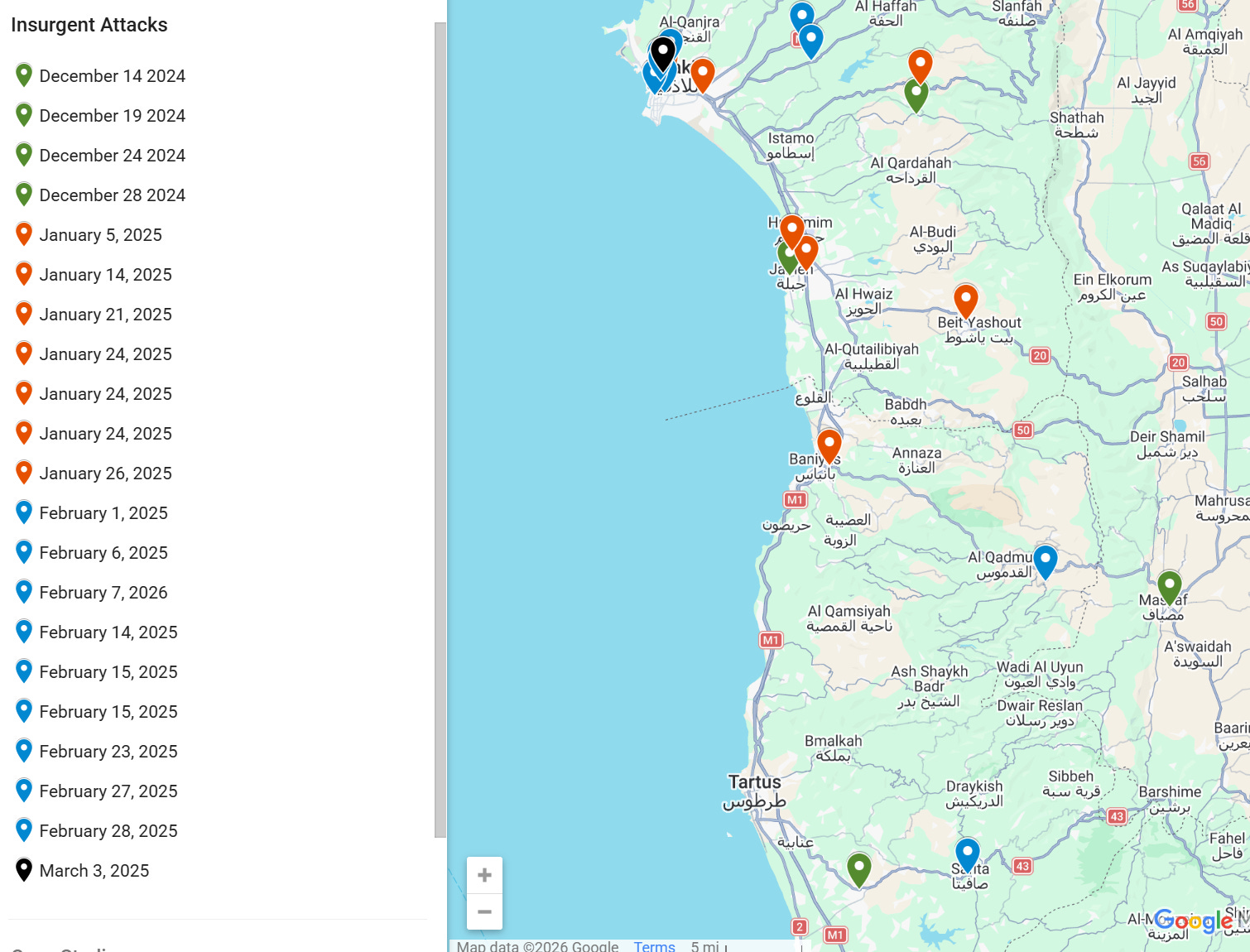
These escalating activities paralleled an increasingly coordinated insurgent network. By late January, attacks began being claimed on behalf of specific Alawi insurgent factions, openly threatening broader violence against the state. These networks were built around a core of ex-regime officers and fighters who flatly rejected a Sunni-run state. Investigations in the months since have shown that these networks were supported and often directed by senior regime officials who had fled to Russia and Lebanon, including Kamal Hassan, Suheil Hassan, Ghiath Dala, and Rami Makhlouf.
These regime irredentists spent the first three months after Assad working to expand their recruitment within the Alawi community. Ex-soldiers were the primary target, with recruiters playing on their security fears and economic hardships linked to the December 2024 taswiya process. However, the insurgents also recruited Alawi men who had never served in the regime’s forces. These recruitment efforts were aided by the amplification of ongoing anti-Alawi crimes by security forces, further bolstered by a constant stream of mis- and dis-information of fake crimes. These propaganda networks would play a crucial role in the mass mobilization on March 6, as discussed below.
The growth of insurgent networks came alongside fierce debates within the coastal Alawi community over the proper response to violations by government forces. Alawi civil society, weak and fractured after decades of Assad’s suppression of civil movements within the sect, were strongly advocating for a non-violent political approach against Alawi disenfranchisement and abuses. But they were fighting a losing battle for influence among the mostly rural coastal community against “the Alawi deep state,” as one activist described it to me in February 2025.
This ‘Alawi Deep State’ was run by militant sheikhs and ex-regime officers who outright rejected any Sunni governance within the country. I met one such sheikh in mid-February 2025, who explained their position bluntly: “We want the new regime to grant us power,” emphasizing repeatedly that the Alawi sheikhs themselves must be given power, not civil activists. He ended the conversation with a direct threat, “we are all in unison and have thousands of trained young men who will take up weapons against the new regime the moment we tell them to.”
The January 2025 violence in western Homs, covered in detail in the COI report, was a catalyzing event pushing more Alawi men towards the militant sheikhs. In a series of violent raids in and around the town of Fahel on January 23, security forces summarily executed 17 ex-regime officers and dozens of Alawi men were arbitrarily detained. The raids triggered local protests and re-flamed Alawi fears that the new government was planning a “slow genocide” of the community and was viewing every ex-regime soldier as guilty for the regime’s war crimes. For its part, Damascus seemed to understand the seriousness of the violations and quickly issued new security policies in the coast. Military factions were withdrawn from every area of rural Tartous and most parts of rural Latakia and village raids targeting weapon caches were halted and instead security forces began coordinating closely with Alawi community leaders to arrange voluntary hand-overs.
While violations in the coast dropped dramatically in February, especially in Tartous, isolated killings and robberies against Alawis continued and insurgent attacks against security forces continued to grow. By late February it was clear that insurgent networks were preparing for a wider uprising, staging mobile weapons caches and hoping to take advantage of some individual spark to mobilize the broader community. Tensions first escalated on February 26, when a reportedly recently hired security member harassed and fought a businessman in Qardaha. This triggered protests in the city while insurgent media pages attempted to mobilize additional communities. That evening, insurgents arrived with a truck loaded with guns to Qardaha’s outskirts, but were quickly intercepted by police. Five days later, insurgents executed two police officers near the Da’atour neighborhood of Latakia city, triggering a security operation in the which government forces killed nine men. Alawi social media accounts spread this news widely, calling it “the Da’atour genocide” and claiming all nine men were innocent civilians. At least one security member was arrested the next day for engaging in sectarian behavior, according to security officials.
Insurgency
On March 6, police officers arrived in the village of Daliyah to arrest a young man. Fearing that he would be executed or disappeared, locals asked if their mukhtar could accompany him to prison. The police agreed and the situation was resolved. However, on their way back to Jableh the bus was stopped by a checkpoint of armed Alawis at the nearby village of Beit Ana, who executed the four police officers and freed the prisoner. As security forces mobilized to respond, insurgents entered the villages with trucks laden with guns and, according to someone in Beit Ana, many teenagers and young men “volunteered” to fight the approaching forces and were quickly armed by the insurgents.12 Responding security forces were then ambushed on the road to Daliyah with all 18 men killed, as reported by the COI and confirmed via local activists.13
It was not an isolated attack, but rather the beginning of the coast-wide uprising.14 As the COI reported, “The attacks in Jablah took place 30 minutes before clashes started in Tartus.”15 According to multiple local activists and ex-regime officers across Tartous, Latakia, and Hama that I spoke with over the past year, as well as investigations using captured insurgent phones and laptops, the core insurgent network had a clear plan to isolate the coast from the rest of Syria. Government checkpoints along every highway were attacked, most captured, and dozens of security forces killed that afternoon and evening.16 Parts of Latakia, Jableh, and Baniyas cities were quickly captured alongside several military installations such as the Istamo Airbase. COI investigators confirmed that insurgents succeeded in capturing or besieging six hospitals across the three aforementioned cities, as well as besieging the Naval Academy in Latakia.17 Other security forces that weren’t wiped out were besieged in their rural positions and took to social media, calling on anyone to some to their aid.18 Early government reinforcements were ambushed at highway overpasses which had been seized by insurgents, resulting in additional deaths among security forces.
The government’s decision to withdraw most military factions from the rural areas of the coast had left interior ministry units undermanned and exposed. By the morning of March 7, the entirety of Tartous’ Dreikish and Sheikh Badr districts had been seized by insurgents, as well as all of Qadmus district aside from the Ismaili-majority city, which was now besieged.19 Most of Baniyas district, all of rural Jableh and Qardaha districts, and parts of Haffeh and the Masyaf districts had likewise fallen to insurgent control. Multiple Alawi activists told me that Russian military forces in Latakia’s Hmeimim Airbase had supplied insurgents with weapons and ammunition in the early hours of the uprising.20
There were two types of insurgent cells on the eve of March 6: those connected to the broader coastal network and ultimately coordinating with external commanders, and local cells of young men who had formed independently of the central networks.21 Both types now mobilized, with the independent cells seeing the movement of other networks and taking up arms to join them. Videos filmed by insurgents on March 6 and 7 show large groups of armed men, some dressed in full military uniforms others in civilian attire, freely walking around captured areas of the coast. Local networks varied from a few dozens of fighters to hundreds, according to residents I spoke with across six coastal districts, meaning thousands of armed men were involved in the initial uprising.
Scores of heavily armed insurgents celebrate capturing the 107th Brigade base in rural Jableh on the morning of March 7
Insurgents, some dressed in civilian clothes others in military uniforms, walk through rural Jableh on the morning of March 7.
Online propaganda networks played a central role in fueling additional recruitment in these first hours. Through social media and word of mouth, insurgents pushed the claim that a foreign military, sometimes Russia, sometimes Israel, would enter the coast in 24 hours once locals had seized the major ports and airbases.22 Media networks further claimed the coastal uprising was part of a nation-wide coup against the new government, encouraging every Alawi man to take up arms. For example, one long-running pro-regime news page with 35,000 followers made a series of claims during the evening of March 6, including that the Russian military had announced it would strike any government convoy entering the coast and had fired missiles at security forces coming from Idlib, and that anti-Damascus coups had been launched by Ahmed Awda in Dara’a, tribes in Deir Ez Zor, and the SDF in Aleppo. These claims were interspersed with videos of insurgents taking control of positions across the coast and of captured or killed security forces.
Yet the insurgency had not spread beyond the coast, largely because those core networks had intentionally not engaged with Alawis in Homs or Hama governorates. According to one prominent Alawi mayor in rural Hama, “the Alawis of the coast don’t trust us, so they did not include us in their plans prior to March 6.”23 The only non-coastal area to rise up was the Wadi Ayoun sub-district of Hama’s Masyaf, which sits deep in the coastal mountains, and the adjacent village of Resafa, which resides on the edge of the Wadi Ayoun mountain range.
Motivations to join the insurgency varied significantly. Certainly, many men joined out of fear for their safety and anger over government violations over the previous three months. Others, especially young Alawi men, were paid to join the insurgents, according to one Alawi community leader I spoke with in rural Tartous. But other insurgents were acting out of sectarian and power-driven motivations, as made clear by the sheikh I met in February 2025. Desires for power and anti-Sunni sectarianism helps explain why the insurgency occurred in many areas where government forces had worked well with the Alawi community, as will be shown in the case studies. The COI report includes an insightful testimony on the violently sectarian rhetoric insurgents used internally:
“Pro-former government forces then abducted the witness and took him to a civilian house in Deir Elbishel village, where he was held with another civilian man from Homs. The witness observed approximately 30 additional armed men in or around the house, with most wearing civilian t-shirts bearing the logo of the “Coast Shield” and others dressed in military uniforms associated with the former Syrian Army. Both victims were beaten, threatened and insulted, including with sectarian slurs. One of the armed men was carrying a sword and threatened to behead one of the victims saying: ‘You are coming to slaughter the Alawis, you dogs’, that: ‘Assad will return to power, and will shut their mouths, rape their women and slaughter them’.”– COI report, page 27
Aftermath
Many of the worst massacres came in the immediate aftermath of the initial insurgent attacks. Surviving security forces and their reinforcements conducted indiscriminate killing campaigns in several towns on March 7 from which insurgents had attacked their positions the night before. This includes places like Mukhtariyah, where dozens of security members were killed on March 6, Qabou, whose nearby checkpoint was besieged throughout the night, Sanobar, from which insurgents attacked a nearby military base, Da’atour neighborhood, whose insurgents had besieged the local police station, and Jableh and Baniyas cities. Other massacre sites were previously highlighted on social media posts as being safe havens for insurgents, even if this was not the case.24 These social media rumors may have played an additional role in which communities were targeted by pro-government forces. This pattern suggests that the insurgency itself played a significant role in determining which areas were targeted on March 7, even if the killings within those towns were conducted with more base sectarian motivations.
The patterns of violations shifted over March 8 and 9, with killings occurring more often in the context of mass looting and displacement as roaming convoys of armed Sunnis, some civilians, some former opposition factions, and others members of state forces, exploited the chaos. This period also saw a common pattern wherein GSS units, which had by now been reinforced, would respond to community calls for help, expel factions committing crimes, and then move to another area at which point another faction would re-enter.25 It was not until the widespread establishment of permanent checkpoints across the region that these daily factional abuses ceased.
Coastal Sunnis played a large role in the retributive violence, owing to a number of overlapping factors. In places like Baniyas and Jableh, Sunni communities were often seeking revenge against the broader Alawi community for the brutal massacres Alawi militiamen had committed against them earlier in the war or during the March 6 attacks. Class disputes also played a role, with wealthy Alawi neighborhoods in particular being targeted by Sunnis coming from disenfranchised towns, especially in Baniyas.26 Across the Sunni community, a deep sense of betrayal was universally expressed. One testimony published by the COI cites armed men telling male Alawis “’Al-Shaara gave you security and you betrayed him.’ before shooting and killing 15 male relatives.”27
The betrayal narrative and accusations against the wider Alawi community were fueled by widely held perceptions that most Alawis knew about the insurgency before it began. Christian and Sunni residents I met with in Baniyas and Latakia in April 2025 all spoke about seeing their Alawi neighbors closing shops early and keeping their kids out of school on March 6, or leaving the cities for their villages the day before. One Christian businessman in Baniyas recalled seeing an Alawi ex-officer packing his family into his car in the evening of March 5, saying to the Christian man, “What are you doing here? Close your shop and leave, everything will be settled soon.” According to one Alawi activist from rural Tartous, there were widespread rumors of an impending uprising within the community due to leaks from ex-officers involved in planning the operation.
The sense of betrayal ran particularly deep in Latakia city, whose Sunni residents had suffered under 14 years of Assad regime oppression. “They have not accepted that the regime is gone,” one Sunni businessman told me during a dialogue session, “we had gathered with Alawi sheikhs and influential men and all agreed on rejecting violence, but now after March 6 they have changed their way of talking and say Sunnis are threatening every Alawi.” Prior to the uprising, Sunnis in Latakia in particular already feared the Alawi ex-soldiers. In my visit to the city in February, every Sunni I met with was convinced that, “the Alawis will never accept living with us as equals and are waiting to take back control,” as one young government worker described. The March 6 insurgency, which most pro-government Sunnis described as a coup attempt, solidified their belief that the Alawi community as a whole was against them.
The insurgency’s failure and subsequent mass killings also fomented a sense of betrayal within the Alawi community. Many Alawi activists in rural Tartous spoke in the months after the uprising of a deep rift that had formed among the insurgents and their sympathizers between Tartous and Latakia. Latakian insurgents blamed those in Tartous for the uprising’s failure, claiming that they had failed to keep the coastal highway cut as was planned. “The former soldiers in Latakia now call the men here ‘traitors’,” explained one resident in rural Tartous.28 Most insurgents in Tartous had fled the moment pro-government reinforcements arrived on March 7, leaving those in Latakia exposed. For their part the insurgents in Tartous felt manipulated by the insurgent leaders in Latakia, who had lied about imminent foreign support. This divide significantly weakened the insurgency’s ability to rebuild, with the remaining networks largely receding to rural Latakia.
In the year since the insurgency and massacres, the experiences and trajectories of Alawi communities that were not attacked and those who survived the mass killings have also diverged significantly. “There is a difference in support [for armed opposition] from region to region,” according to an ex-regime officer, “based on what is happening in each region and where the massacre happened.”29 As the new government has made continued improvements in its treatment of and relations with coastal Alawis, there has been a reduced degree of fear and anger and many people started returning to their daily lives. Yet there have been no attempts by the government to reconcile with communities impacted by violence, leaving those residents still deeply angry and constantly afraid of new killings.
According to the former regime officer, insurgent networks have attempted to leverage this anger into renewed recruitment. “Alawis are full of hate right now,” he told me in a meeting in July, “I asked an Alawi woman recently, ‘What if the government falls and Alawis take over,’ and she said, ‘I would ring the blood of Sunnis,’ and this is because they killed her family in Sanobar.” Yet even here, the false promises of foreign intervention are not forgotten. Now, insurgent networks tell their recruits to wait until the always unspecified foreign country, “gives the green light.”
The way the insurgency unfolded has changed the new government’s strategy in the coast in the year since. While increasing government distrust in ex-regime soldiers, it also pushed Damascus to engage directly with them through ex-regime interlocutors like Fadi Saqr and Khalid al-Ahmed. Empowering these regime war criminals in order to prevent a new uprising has only further alienated those Alawis who oppose armed opposition. The insurgency also resulted in a renewed securitization of the coast, with dozens of new checkpoints and bases manned by military factions erected across rural Tartous and Latakia. Members of these forces would continue to commit crimes against Alawi civilians throughout the summer of 2025. At the same time, it was clear the GSS had a central role as a disciplined security force that could effectively engage with Alawi communities, and expanding the GSS became a priority. This expansion eventually paid off, with security and trust building improving significantly since late 2025.
Case Studies
The following case studies examine how the insurgency and subsequent retaliation by pro-government forces played out differently across ten different areas; one in Hama, five in Tartous, and four in Latakia. These represent different patterns of insurgency and violence, and also underscore the important role that local Alawis played in protecting security forces in some areas. Each case study demonstrates some aspect of the events discussed in the above sections, but of course they do not represent every community’s or individual’s experiences those days.
Resafa
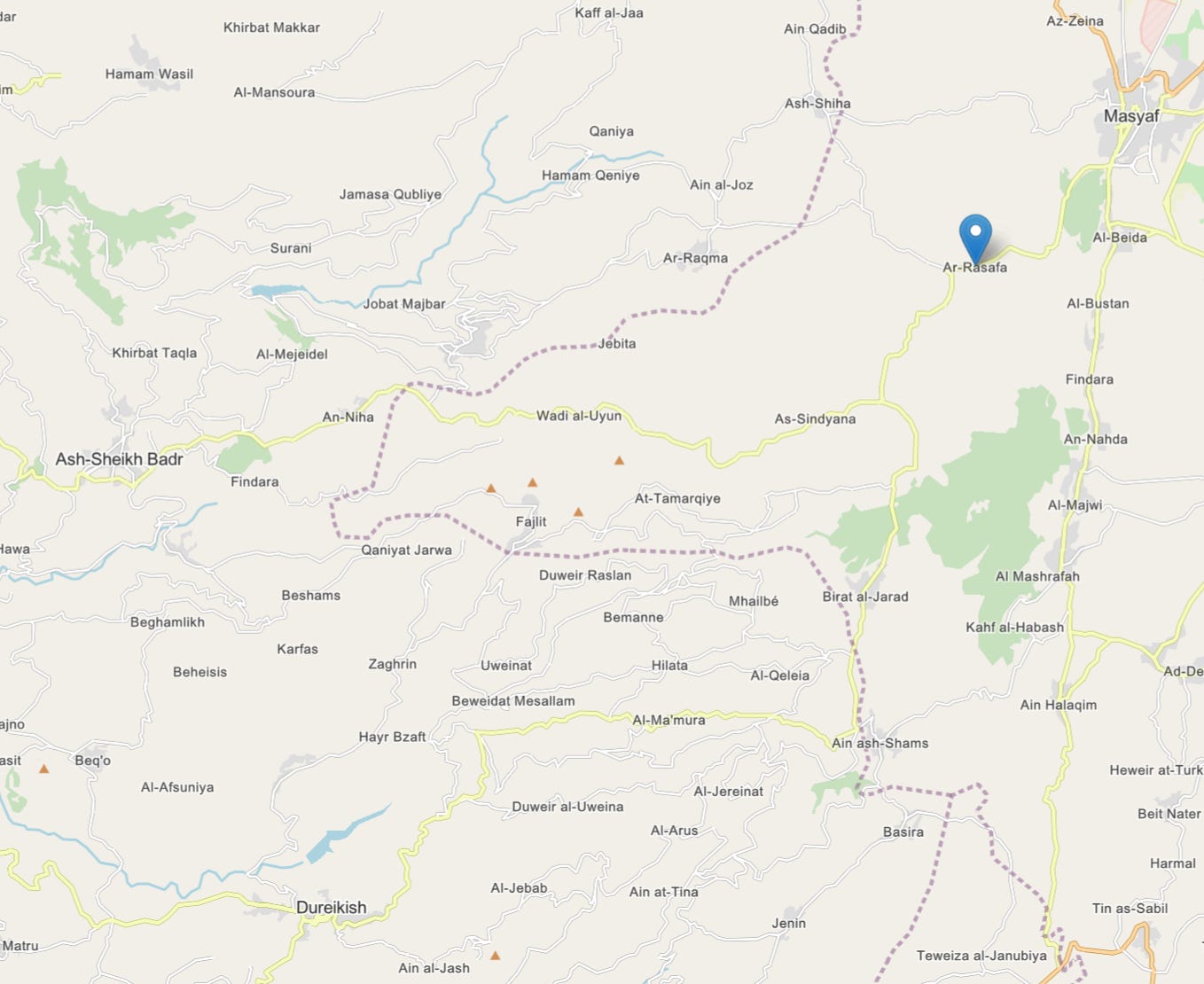
Resafa is one of the most infamous massacre sites the March 7 and was heavily covered by western news outlets. The events of the town are emblematic of a broader pattern across the coast, where pro-government massacres can often be matched to the severity of insurgent activities. Three neutral sources provide a fuller picture of the events in Resafa, based on their conversations with survivors. All three narratives come from non-Sunni activists and aid workers from Dreikish, Masyaf, and Salamiyah who have visited the village throughout 2025.
Resafa represented the eastern edge of the core insurgent network, with most Alawis in the rest of Hama and Homs being left out of insurgent plans in the weeks prior to the uprising, according to one prominent Alawi leader in Masyaf. Large insurgent groups mobilized in Wadi Ayoun, where the government had no presence at the time, and moved west into Tartous’ Sheikh Badr and Dreikish districts to secure the countryside.30 Resafa, which has an outsized number of ex-regime fighters compared to other Alawi villages in Masyaf, sits at the edge of the coastal mountains on the highway leading to Wadi Ayoun, Dreikish, and Sheikh Badr. It was therefore a key position for closing the government’s access to Tartous governorate.
When news of the uprising in Tartous reached forces in Masyaf, a large security convoy departed Masyaf city heading towards Tartous via the Resafa road. Upon reaching the village, the highway takes a steep uphill turn. Insurgents from Resafa and the nearby town of Sindiyana had coated this turn in oil, causing the vehicles to slip and stall at which point the insurgents shot and killed all 16 security members. On the morning of March 7, another convoy was dispatched, and upon reaching the ambush site and seeing the dead bodies outside the village, entered Resafa and began executing men and teenagers, killing 65 residents according to the COI. Some residents would later tell aid workers that, “the insurgent attacks brought the massacres to Resafa.”
Sheikh Badr District
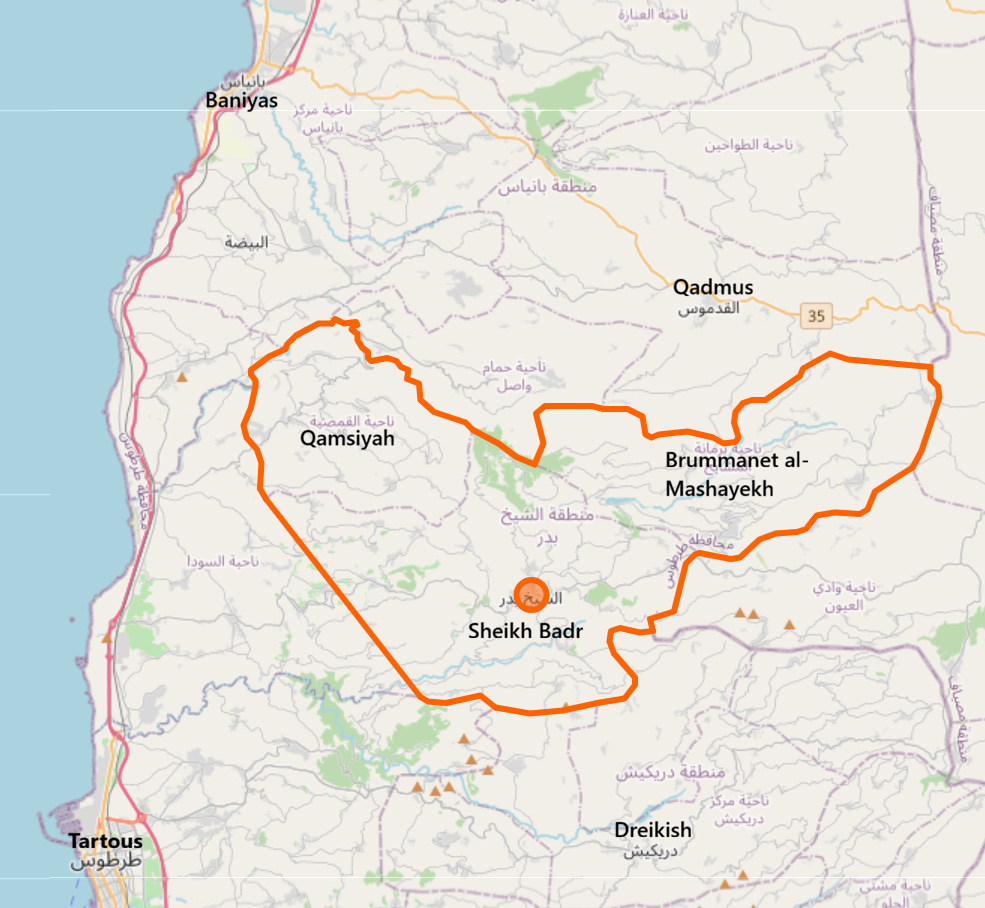
The government security presence in Sheikh Badr was extremely limited since December 2024, thanks in large part to more extensive cooperation between Alawi mukhtars and GSS officials than in other parts of the coast. At the time of the insurgency there were only a handful of GSS officers in each of the district’s three subdistrict offices.31 Despite the absence of crimes or violations in the district during the first three months after liberation, insurgents still mobilized and quickly seized the isolated security offices.32
In the eastern subdistrict of Brummanet al-Mashayekh, a large convoy of insurgents, numbering more than 100, arrived from the Wadi Ayoun area of Masyaf and quickly captured the small GSS office, according to the security official for the area. However, the GSS officials here had spent the past three months building strong ties with the local Alawi community, including establishing a civil council through which it supported community needs. This civil council was able to negotiate with the Wadi Ayoun insurgents to prevent the killing of the GSS members, and local Alawi civilians then smuggled the security forces to Tartous city under the cover of night.
In Sheikh Badr’s western subdistrict of Qamsiyeh, local insurgents similarly besieged the small General Security outfit on the evening of March 6. Insurgents here were led by an ex-brigadier general, according to a resident from the town, but, “they were mostly just following orders, so they weren’t as violent.” The Qamsiyeh insurgents allowed the besieged GSS men to withdraw safely to Tartous, avoiding any bloodshed.
With all of the GSS officers safely secured in Tartous thanks to the support of local Alawis, they were able to lead the entry of government forces back into Sheikh Badr on March 9. Prior to their return, the officers contacted the influential mukhtars of the district and asked them to gather residents’ weapons. “The General Security said that our area had been good and cooperative, so they were fine with this peaceful resolution,” explained one local activist working as an interlocutor with security officials.
This act reduced tensions as security forces re-entered. As happened in Qadmus and Dreikish, the first car in the government convoy contained the GSS commanders. The personal background and power of the GSS officers here and their close ties with the local mukhtars enabled them to keep a stronger hand on faction abuses than in other areas, and within a few days of their return most factions were withdrawn from Brummanet al-Mashayekh, and in Qamsiyah were largely confined to a few bases. Altogether, these dynamics prevented killings from occurring in Sheikh Badr district.
Qadmus District
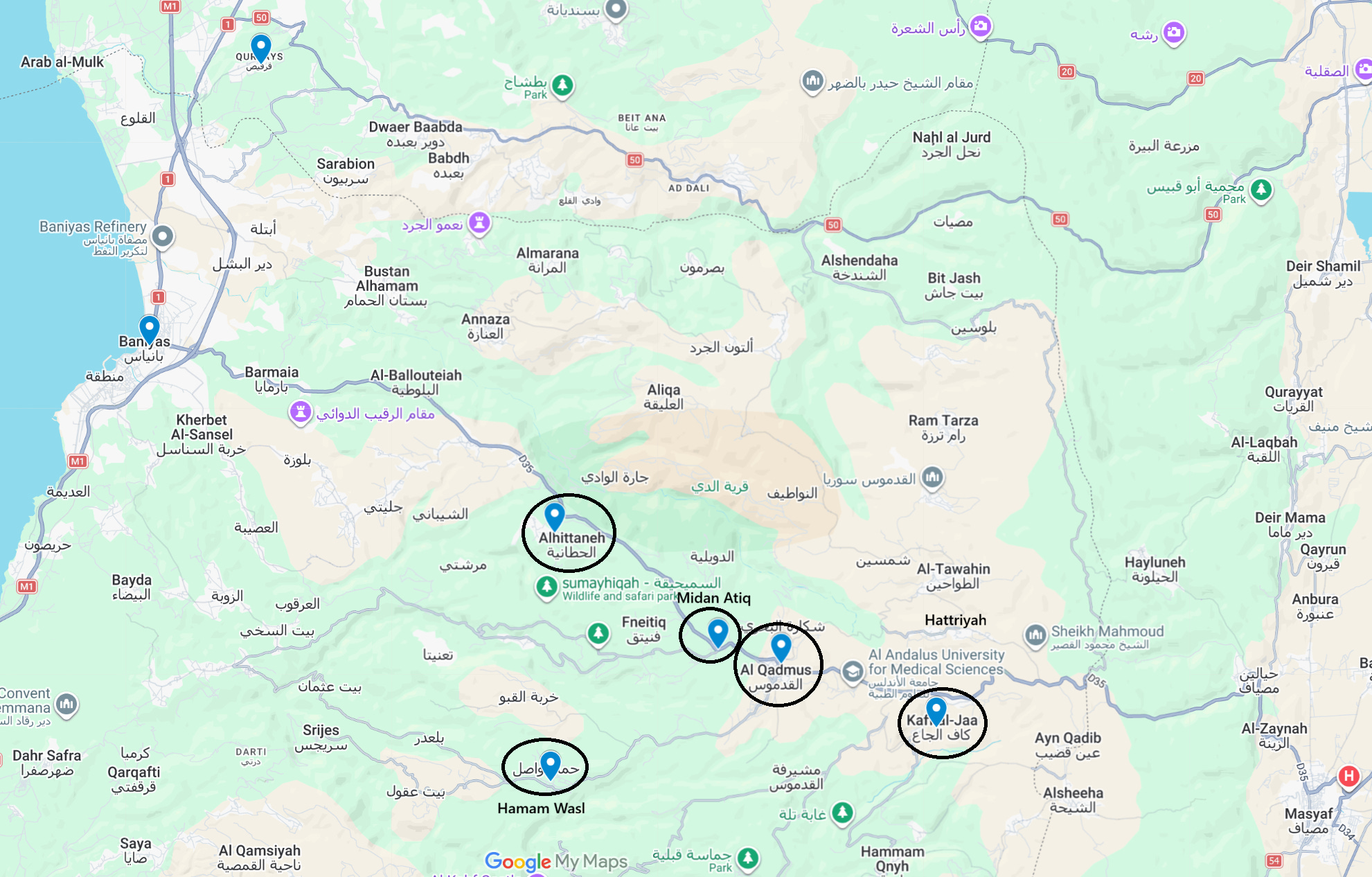
The origins of the Qadmus insurgency and killings lie in the first two months after liberation. While Qadmus city is majority Ismaili, and strongly pro-revolution, several villages in its countryside were strongholds of regime support. Chief among these is Hamam Wasl, in which 20% of all residents served in the regime’s forces. Two ex-regime officers in particular were seen as holding the most influence over the former soldiers, Ali Melhem and Yousef Safa.33
General Security officials adopted an extremely open approach to Hamam Wasl and the other Alawi villages in January 2025, meeting with local leaders and ex-regime officers and offering to arm small groups of Alawi ex-soldiers to man local checkpoints. Around 80 such checkpoints were established in 40 Alawi villages in Qadmus, all manned by ex-regime Alawi soldiers, according to multiple security officials and Ismaili activists involved in the initiative. “I knew that the former soldiers were angry,” explained Abu Huzayfa, the Qadmus Security Director, who made the program, “so my goal was to make them invested in the new state by giving them responsibilities.”34 As part of the initiative, Abu Huzayfa and his deputies held daily meetings with Hamam Wasl’s Melham and Safa, often sharing breakfast with each other.
The approach failed. On February 28, two Ismaili security volunteers were executed by insurgents at one such checkpoint in Kaf Jaa, a remote village surrounded by caves later believed to safeguard insurgent cells. On March 6, two GSS members and an Ismaili volunteer were lured into an ambush by the mukhtar of Midan al-Atiq, who had made a request to meet with the GSS. All three men were executed by local insurgents upon entering the town.
The ambush marked the start of the Qadmus insurgency. Alawi and Ismaili activists place the number of insurgents in the district at 700 to 1,000. “Only around 20 villages really joined the insurgency,” explained one Alawi media activist, “and many of the fighters joined once they saw the area had been ‘liberated’.”35 All those interviewed agreed that most of the Alawi men who the GSS had given weapons and assigned to local checkpoints joined the insurgency.
That evening, just a few hours after sharing tea in his home, Ali Melhem called Abu Huzayfa and told him his fighters were coming to Qadmus, “to cut off your head.” Melhem and Safa, who it turned out were serving as the Qadmus region commanders of the Coastal Shield Brigade, had mobilized around 150 men from Hamam Wasl. Other similarly-sized cells rose up to Qadmus’ east and west, cutting the roads to Masyaf and Baniyas, and then marched on the city. Ismailis grabbed what weapons they could and took to the streets to defend their city alongside the small group of 15 police and GSS members.
“They said ‘we will come to Qadmus and massacre you all if you do not hand over the security officials for us to kill,’” described one activist involved in the negotiations, who also emphasized that none of the Alawi residents of the city itself supported the insurgents.36 Several influential Alawi leaders quickly stepped in to try and prevent more violence and an attack on the city. In eastern Qadmus, one prominent mukhtar immediately contacted Abu Huzayfa and the GSS office when news of the uprising reached him. In coordination with the Ismailis in Qadmus city, he was able to negotiate the safe passage of the GSS and police units out of Qadmus to Masyaf, and in turn received promises from the insurgents not to attack the city. Following the March 6 events, this mukhtar would become a key interlocutor for security forces working to rebuild trust and root out insurgent cells in rural Qadmus.
The next morning, at around 9am on March 7, insurgents ambushed two vehicles of pro-government fighters from Maghawir Ahrar attempting to reach Baniyas via Masyaf. The group, which was not merged into the Ministry of Defense at the time, had come from Homs city and thought Qadmus was still under government control. They were ambushed along the main highway near the town of Hattriyah. Nine of the fighters were killed instantly. The surviving two men were taken by insurgents to the private hospital just outside Qadmus city, which they had seized the night before. In order to rescue the men, a few Ismaili activists smuggled themselves into the hospital and snuck the wounded fighters out, securing them safely in an Ismaili home until the GSS arrived on March 9.
The situation remained like this for two days, with the Ismailis and Alawi and Sunni residents of Qadmus city trapped and cut off from the rest of the country. Ismailis began receiving hundreds of WhatsApp messages from local numbers, all threatening them and their families for ‘siding with the government.’ Yet as news spread of the massacres being conducted by pro-government forces and armed Sunni civilians across the coast, residents in Qadmus became equally afraid for their own safety. Rumors spread that the pro-government faction responsible for some of the worst crimes in Baniyas city was nearby and might soon enter the Qadmus region. Ismaili leaders were in regular contact with the security officials who had been safely evacuated, who promised them that they had explained the situation of the Ismaili community to other commanders and were trying to make sure no extremist factions would enter the area.
Yet on March 9, when the pro-government factions began entering Qadmus from Baniyas, there were only 12 GSS officers in the convoy. “They had no power over the factions,” explains one of the Ismaili coordinators, “and only when the convoy reached Qadmus was the senior official able to say, ‘this town is with us, don’t touch anyone,’ and the GSS took over the town.”37
These convoys included HTS units and one local faction known to have been involved in killings in Baniyas. According to Ismaili leaders who coordinated closely with government officials organizing this convoy, the local faction had departed from Baniyas first, spurring the quick deployment of the GSS and HTS units to try and ensure the faction did not commit new massacres.
Yet the factions had already committed killings and arson in three villages on their way to Qadmus city. While the specific people who were murdered were random, the three villages were clearly targeted for specific reasons. Two men were killed in Hamam Wasl, one was killed in Midan al-Atiq, and 14 men killed in Hattaniyah, with dozens of homes burned as well. According to several sources, pro-government fighters had already identified each town as having been a source of significant numbers of insurgents. Additional rumors then spread among the MoD and factions that they would face resistance in Hattaniyah, which, “may have contributed to their targeting,” according to one Alawi activist in the area. In Hattaniyah, one remaining insurgent shot at the faction convoy as it approached on March 9,38 resulting in the faction raiding the town and gathering and executing 14 men in the nearby shrine. “Most of the men in Hattaniyah were part of the insurgency,” according to one Ismaili activist involved in civil peace work in the countryside, “but the 14 killed there were just random people, because the insurgents had all fled by the time the factions arrived.”
In Midan al-Atiq, the pro-government factions went directly to the mukhtar’s house and executed him for his role in killing the Ismaili and Sunni security men on March 6. But the main objective of the convoy was Hamam Wasl, where the leaders of the Qadmus insurgency were from. By the time the factions arrived, however, everyone in the town had fled aside from two elderly disabled men. The factions executed these two men and burned several homes, including the home of Ali Melhem.
When the military faction from Baniyas reached the outskirts of Qadmus city they began vandalizing homes and shops. One Ismaili resident went out to stop the looting, confronting one of the faction men and asking him why he was destroying the property. “He told me, ‘I am not here on military orders. My entire family was executed by the regime and I’m here for revenge’,” the resident recalls. Locals were able to contact the arriving General Security officers who quickly intervened and stopped the violations.
General Security units spent the next two months trying to prevent and resolve continued violations by these military factions until the factions were eventually withdrawn. Abu Huzayfa remains the security official for the district and continued to engage both the Alawi and Ismaili community after his return, working to rebuild trust and ties between the communities and with the state. “My brother was killed on March 6,” Abu Huzayfa told me in May, “but I will still push for peace, I know this is what is required to build a future.”
Khirbet Maazah Subdistrict
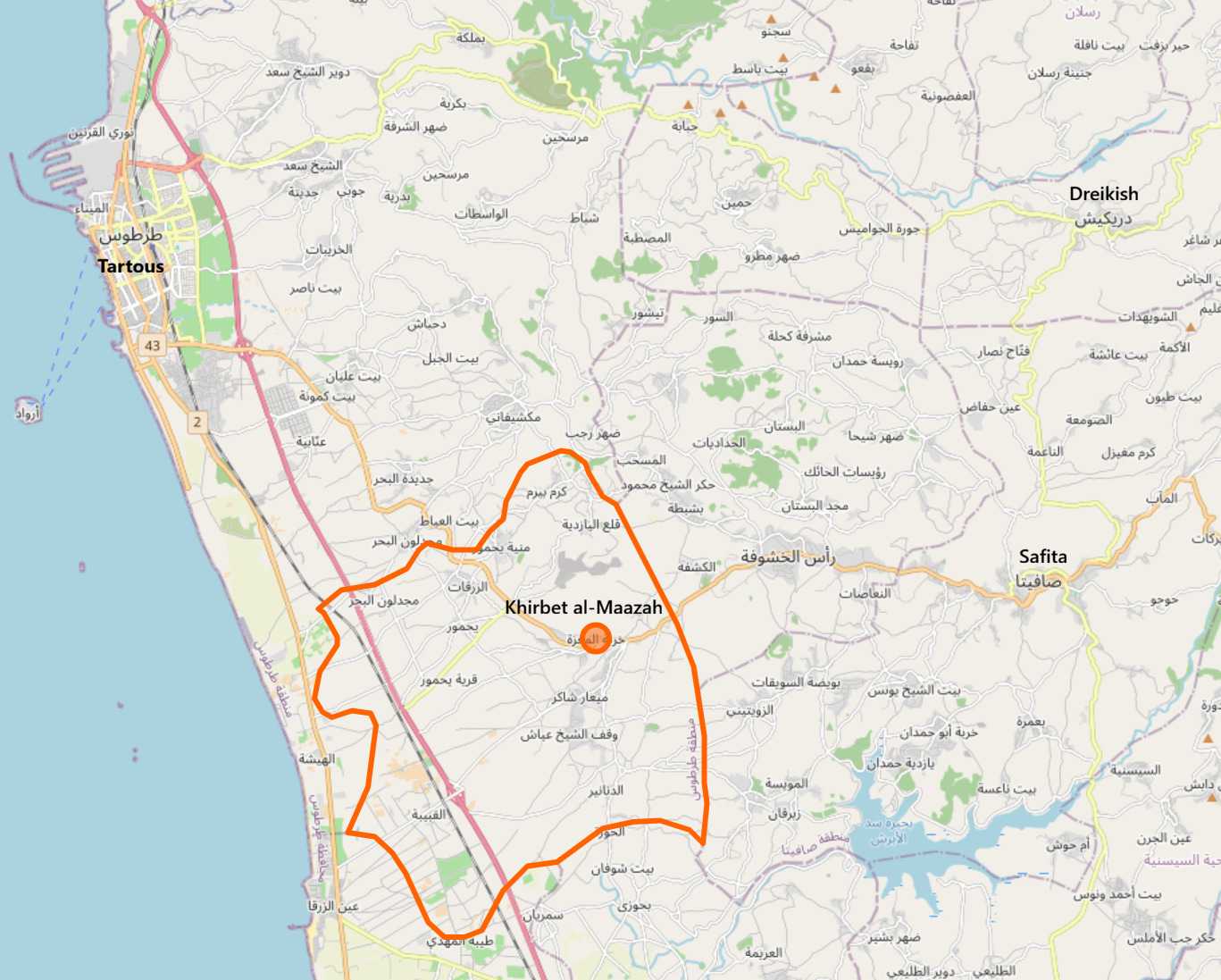
The Khirbet Maazah subdistrict sits on the southeast edge of Tartous city, straddling the highway to the Christian city of Safita in southern Tartous. The area was the scene of the first major insurgent attack on December 24, 2024, but persistent trust-building by security officials and locals since that moment have forged close ties between residents and the General Security here. This foundation was critical for largely protecting the area from violence on both sides in March.39
I previously published a detailed history of these trust building steps and the events of March 6 in Khirbet Maazah, found in the below link. A summary of the March events follows.
Violence and Diplomacy: A Tale of Two Alawi Towns

This is the latest edition of my ongoing series highlighting the experiences of Alawi communities after the fall of Assad. I encourage readers to also read my past reports on Bahluliyah, Baniyas, and
Due to the ex-Assad uprising in December 2024, the subsequent security operations, and the close engagement by security officials, the Khirbet Maazah area had little local support for the March 6 insurgency. As a result, GSS units were not only not attacked, but senior officials immediately dispatched additional units to protect the area. A new GSS checkpoint was established on the main road into the area from the coastal highway, which soon came under pressure from pro-government factions.
In one of the most clear examples of the absence of high-level government coordination for the subsequent violence in the coast, these factions attempted to force their way through the MoI checkpoints to the point that GSS personnel had to fire into the air to prevent their advance. After negotiations between the MoI and faction leaders, the factions were allowed to pass and move towards Safita, with the understanding they would stay on the main road. Yet several faction vehicles used side roads to reach the villages of Yahmur and Zirqat, where they killed two civilians and looted some homes. In Yahmur, one local man fired his pistol in the air near faction members and then fled. The next day he returned on his motorcycle, driving back and forth alongside the faction, whose members eventually shot and killed him. These three men were the only ones killed in the area.
Small violations occurred during the four days these factions traveled to Safita, like car theft and looting of businesses along the road and shooting in the air from their camps at night to scare residents. During this later event, General Security personnel intervened, forcing the factions to cease their fire. Later, MoI officials would also coordinate the return of much of the stolen property from the factions. “In general the situation was good and stable,” says a local Alawi activist, “but there was still a huge amount of fear.”
Dreikish District
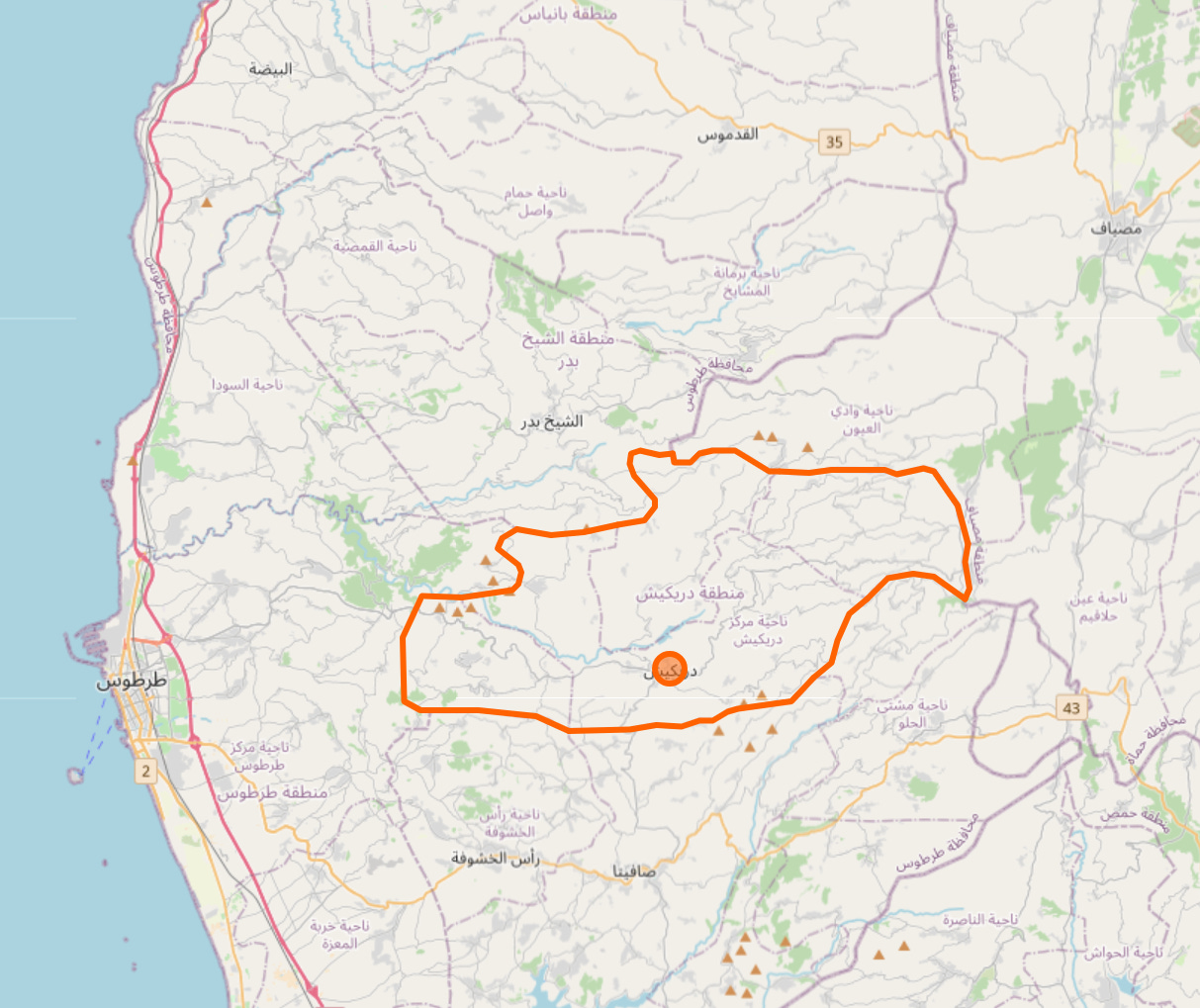
Dreikish district sits directly east of Tartous city, its towns containing both highly educated, art-oriented communities and many families which were close to the regime’s security forces. As a result, it was one of the few coastal communities to form its own civil peace committee after the fall of Assad and work closely with the new security officials. The first officials assigned to Dreikish were very welcoming, according to Abu Ahmed, a member of this committee, treating the population with respect and engaging closely with them to resolve any security issues. “For three months we had no problems and no events,” one local activist told me during the summer.40
Just like in Khirbet Maazah, the first security challenge here came on the morning of December 24, when the video of the Qussaibi Shrine burning went viral on Facebook. According to Abu Ahmed, “this resulted in an insurgent moving building.” But unlike in Khirbet Maazah, the civil peace committee was able to intervene and prevent any violence against security forces. “We thought the same thing was happening March 6 when saw news of shootings across the coast,” he told me, “so I talked to Abu Zein [the district director] about how to stop it, but Abu Zein said just stay home because this is looking way bigger than anything we can deal with.” As with the rest of rural Tartous, Dreikish was held by only a handful of GSS men, 15 in total, with no nearby army units to support them.
The civil peace committee members helped the GSS officers return to their office that afternoon, with some members even retrieving some of the police cars which had been stolen by locals as the insurgents mobilized. An Alawi sheikh, known as “Sheikh Alaa,” who had been a member of the committee, took Abu Harith in his car, offering to drive him home. Instead, he kidnapped Abu Harith and delivered him to the insurgents, with whom which he had secretly been working. “We didn’t even consider that Abu Harith was killed three days later because we knew that he had gotten in the car with a man he knew,” Abu Ahmed explained, “We assumed he was safe.”
Abu Harith would remain missing for months, only confirmed dead when his body was found in the woods in June 2025. On March 7, the insurgents attacked Dreikish city, besieging the police station and the remaining 14 security personnel. Sheikh Alaa, now leading around 55 armed insurgents, captured the security members later that day. By now, however, news had reached the insurgents in Dreikish of the pro-government mobilizations elsewhere and the failure of the insurgents in Latakia. Sheikh Alaa attempted to save face by publishing a video of the captured GSS men claiming he had “found them,” and offering to hand them over to officials in Tartous. The anti-insurgent members of the civil peace committee, like Abu Ahmed, entered into negotiations with Sheikh Alaa, ultimately securing the release of the survivors and their escort back to Tartous. However, Abu Harith was missing, and a second GSS member had been killed in the fighting, and everyone now suspected Sheikh Alaa’s involvement, so he fled the area.
On March 8 the pro-government factions began to move down the highway from Tartous city to Dreikish. At this point, Dreikish’s wealthiest local, a businessman named Nizar Assad, began calling senior government security officials in order to get a hold of the faction commanders approaching Dreikish. The murder of the two GSS members had terrified locals, knowing that the factions would now want revenge. According to several local accounts, Nizar paid large sums of money to the faction leaders for them to cease their advance. On March 9 they paused at Hmeen, 10 kilometers from the city, and began establishing checkpoints on the road and issuing threats online that they would kill Alawi residents. Nizar Assad then pressured the insurgents in Dreikish not to attack these new checkpoints in order to prevent a new round of clashes and open the door to mass reprisal killings. “Everyone kept to their houses and this is what saved us,” says Abu Ahmed, “I was calling everyone to keep them calm, yet I was terrified and anxious.”
At this point the remaining civil peace committee members contacted the GSS survivors now in Tartous, requesting that they return to Dreikish. They did, telling locals that, “we are protecting you from the factions who want to kill you for killing Abu Harith.” For two weeks the GSS maintained a cordon around Dreikish city, preventing factions from entering the city or the deeper countryside villages and committing any serious violations.
Baniyas City
Baniyas city experienced perhaps the most violent and prolonged assault of all areas in March. The city was the focal point for Tartous’ insurgent networks, experiencing the most significant anti-government violence during the evening of March 6, which then devolved into multiple days of killings, looting, and vandalism by pro-government security forces and armed Sunni civilians against Alawi neighborhoods. Much of the violence here is rooted in the massacres committed by Alawi militias against local Sunnis in 2011 and 2013, which left hundreds of men, women, and children dead and houses destroyed to this day.41
A lengthy account of the March violence in Baniyas can be found in my previously published report containing two eyewitness perspectives. A summary of the key events follows. Much of this account comes from George (not his real name) a Christian activist who has heard first-hand testimonies from Sunni and Alawi residents in the months since the violence.42
Baniyas Massacre Through the Eyes of Survivors

“Five times that night I had a gun to my head.” This is the first thing “J” says when asked what happened on March 6. “My niece and her husband were killed in front of me,” he says it flatly. “My fri…
The violence in Baniyas began on March 6, when insurgents ambushed General Security forces and armed Sunni volunteers at the city’s highway entrance. At least eight security members were killed and the Baniyas hospital and security office were quickly besieged.43 Some insurgents had come from the nearby villages, but most had been living in the Alawi-majority Qusour and Muruj neighborhoods and now took up positions on some of the building rooftops in these neighborhoods.
Many security forces in the Baniyas countryside came under attack at the same time. Scores of wounded and dead GSS members were brought to the Baniyas hospital that evening and night, some by boat from elsewhere along the coast in order to avoid the insurgent forces. According to George, between 150 and 200 security members, wounded and killed, were brought to Baniyas that night.
Yet unlike in Jableh, where insurgents would hold their positions well into March 7, in Baniyas the fighters quickly abandoned the battle. “They realized there was no foreign intervention coming and they had been tricked by the regime media and leaders and had made a huge mistake,” George explained.44 By early morning on March 7, armed Sunni civilians from the nearby villages of Bayda and Marqab, along with Sunnis from Baniyas city, had joined newly arrived government forces and entered the city. “They realized there was no foreign intervention coming and they had been tricked by the regime media and leaders and had made a huge mistake,” George explained.
At least five different pro-government armed factions moved through Baniyas city from 10am on March 7 until the morning of March 8. The insurgents had long been killed or fled by this point, but the factions continued to raid Alawi homes in Qusour neighborhood, killing residents, stealing valuables, and burning some homes.
Central to the post-insurgent violence in Baniyas was the role of local Sunnis, many of whom were acting on a decade-long desire for revenge for the crimes committed by the Assad regime and local Alawi militias early in the war.
“They came with the foreign factions and agitated them. The foreigners didn’t want to kill anyone initially but they [the people from Bayda and Marqab] kept demanded the foreigners kill certain people. Despite everything, this is just a natural reaction to the massacres against them, because all of their families were killed in such a random and indiscriminate way by regime men, they don’t know who exactly was the culprit and just reacted with the same random type of killings in Qusour.”45
Most survivors of the massacres I spoke with guessed that the local Sunnis were responsible for as much as half of the killings in March. Some of the earliest killings on March 7 were committed by armed Sunnis from Bayda and Marqab who had followed the first factions through Qusour. “Even before the massacre there were armed groups of IDPs returning to Bayda from the north and calling for revenge against Baniyas Alawites,” George told me in the fall of 2025, “There are some [civilian] men who still walk around the city bragging about how many Alawis they killed.”
Yet, as in other parts of the coast, local Sunnis also played a role in preventing violence. Everyone I have spoken with in Baniyas knows an Alawi family that was saved by their Sunni neighbors.46 One Alawi survivor, a well-known activist who had organized anti-Assad protests in 2011, recalled how a masked man accompanying some faction members saved his life that night by telling them that he, “was a good one.”
“Some armed men tried to enter my apartment building, which has Sunni, Christian, and Alawite families, and so one of my hijabi neighbors came out and yelled at the men until they left. I had other Sunni friends who were killed by insurgent snipers when the fighting began as they tried to help some Alawi families escape.” - George
Late on March 7, the prominent Baniyas revolutionary Sheikh Anas Ayrout began to intervene. According to multiple local sources, Ayrout gathered some General Security members and established the workers housing block at the Baniyas Cement Factory, just outside the city, as a safe haven for Alawis.47 Ayrout and the GSS men then began escorting civilians to the refinery amid the factions’ violence. The COI investigation confirmed this intervention, as well as reporting that the GSS guarding the Alawis clashed with armed factions:
“During the afternoon of 8 March, people heard that they could go to the Masakin school where they would be safe…Another witness described General Security organizing vehicles, including a bus, to bring Alawis to the Masakin school, and once there, they distributed tinned sardines and bread. Witnesses reported that Masakin school was attacked during the night of 8 or 9 March, reportedly around 9.30 p.m. Unknown armed people attempted to enter the school. They opened fire on General Security who returned fire alongside their backup personnel. The Alawi civilians reportedly stayed in the Masakin school for a few days.”48
While security improved in Baniyas by late 2025 and sectarian harassment from security forces has ended, the city remains deeply divided. Nothing has been done to address the widespread violations committed between March 7 and 9, nor the regime massacres committed in 2011 and 2013.
Jableh City
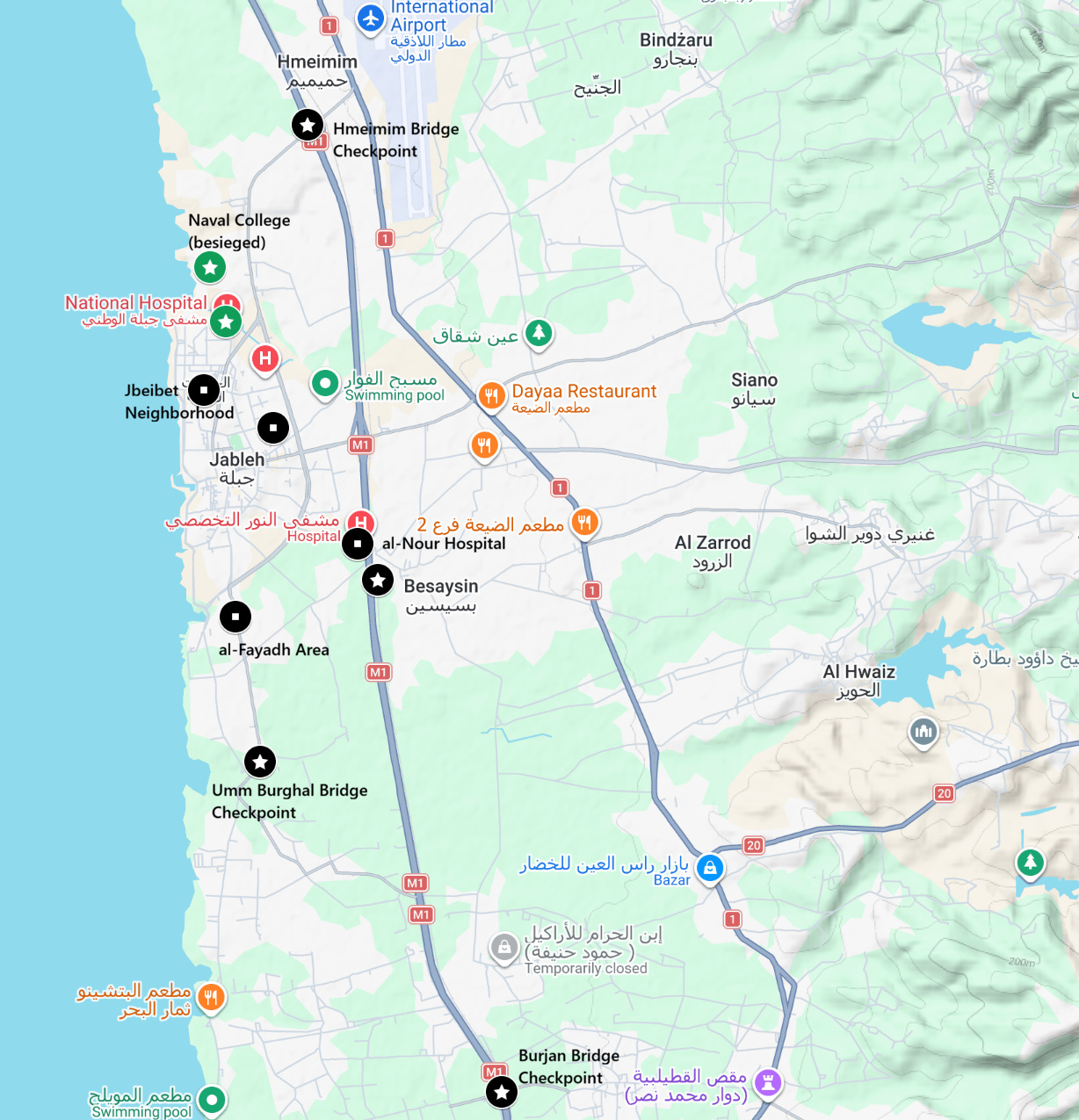
Jableh city and its immediate countryside saw some of the most intense insurgent activity and Alawi killings. The insurgency’s heart was in the Daliyah and Beit Aana region east of Jableh, but insurgent cells had mobilized across the plains around the city as well. Between the evening of March 6 and evening of March 7, insurgents had seized every checkpoint around Jableh city, taken over the northern and eastern neighborhoods,49 besieged the Jableh National Hospital, the city’s security office, and Naval Academy on the city’s northern outskirts, and captured the al-Nour Private Hospital.50
The UN’s Commission of Inquiry reported extensively about the events in Jableh. According to the COI:
“On 6 March, at around 7 p.m., the Jablah national hospital was surrounded by these fighters until the evening on 7 March. At the same time, PFGFs stormed the Al Nour private hospital, also in Jablah, and prohibited medical staff inside from leaving the facility until late afternoon on Friday, 7 March. PFGFs forced medical staff to treat their injured fighters and stored ammunition inside the facility. Medical services were disrupted for several days.”51
In all of these positions, the small security detachments were mostly killed. For example, in the pre-dawn hours of March 7, insurgents from Burjan village seized the nearby highway overpass, using it to fire on any vehicle attempting to reach Jableh city. Just east of the city, insurgents erected a checkpoint outside the village of Bisaysin.52 One mile south of the city, insurgents in Zuhriyat, a rural, dispersed farming area, had seized the Umm Burgal Bridge checkpoint in the early evening of March 6, killing six security members and opening the door to the southern suburbs of Jableh city.
The city was now encircled, with insurgents attacking or having already captured the northern, eastern, and southern neighborhoods. When insurgents entered the city’s southern Sunni neighborhoods they began, according to SCM, “carrying out sectarian killings against the Sunni component.” The storming of the southern neighborhoods triggered calls online for Sunni youth in Jableh to mobilize in response.53 Syria Direct report on this moment, quoting a local resident as saying:
“‘While first storming the city’s southern neighborhoods, regime remnants carried out sectarian killings against the Sunni component…[prompting]…Sunni youth to announce a public mobilization in the city and pursue the regime remnants to stop them from taking control of the city. They broke the siege on hospitals that were besieged by groups affiliated with the former regime.’”54
The first significant pro-government forces were deployed to Jableh throughout March 7, joining many local Sunnis who had taken up arms to defend the city. As the military operations against armed insurgents proceeded, violations and killings against unarmed Alawis increased, as well as looting and vandalism against both Sunni and Alawi homes.55 The following 24 hours mirrored the events in Baniyas closely, with armed pro-government fighters engaging in widespread looting and killing unarmed Alawi men. As in Baniyas, many of the factions that arrived were then joined by local Sunnis, who directed faction members to Alawi areas.56 As reported by the COI, most killings in Jableh city specifically targeted Alawi men, often explicitly framed as revenge for the crimes of the Assad regime.
However, as in Baniyas, these crimes were not centrally directed or uniform across all units. According to one Alawi survivor, the security director for Jableh, a young HTS veteran named Sajd Allah Deek, was seen trying to protect Alawi homes from faction members throughout the evening, at times threatening and verbally fighting with factions to prevent them from entering homes.57
Qurfeis
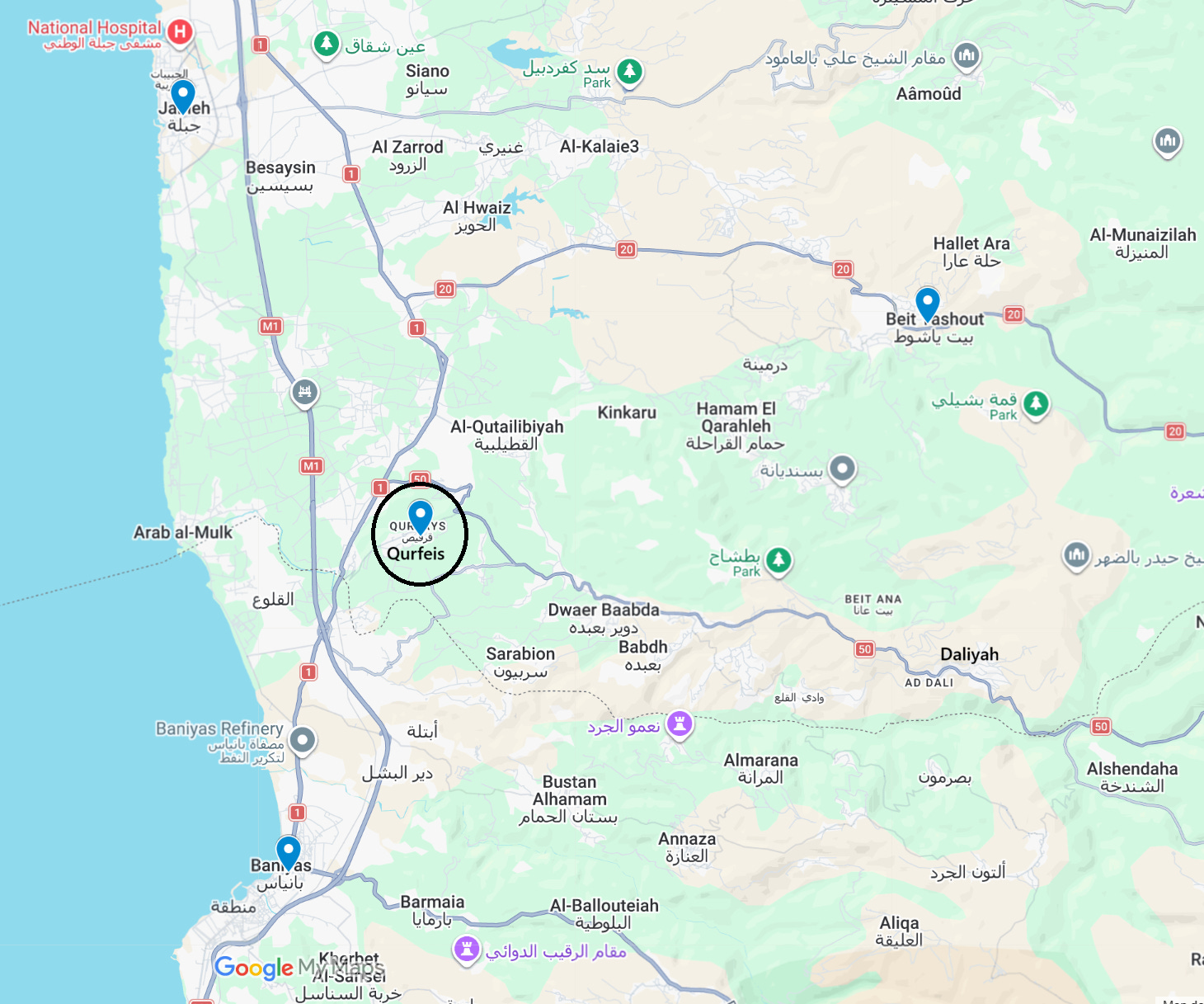
Qurfeis resides between Daliyah and the coastal highway on the edge of a large cliff overlooking the Jableh plains. It is the home of the most revered Alawi shrine in Syria’s coast, and endured several months of violence and abuses from government military factions, as I have previously profiled:
Violence and Diplomacy: A Tale of Two Alawi Towns
This is the latest edition of my ongoing series highlighting the experiences of Alawi communities after the fall of Assad. I encourage readers to also read my past reports on Bahluliyah, Baniyas, and
No insurgent activity emerged from Qurfeis, with all anti-government attacks occurring in either Daliyah, to the east, or along the highway near other villages to the west. Nonetheless, once Jableh city had been secured, the factions which had previously been deployed in Qurfeis and had withdrawn on March 6 returned.
On March 7, a convoy of former HTS fighters from the Othman Brigade, which had been stationed along the highway and come under heavy attack the night before, moved towards Qurfeis. According to a media activist from rural Jableh and a resident of Qurfeis, these faction passed through most of the Jableh plains without incident, heading directly to Qurfeis. They entered the town from the west, just off the coastal highway, passing through the village of as-Sin first. According to Karim (not his real name), a local activist from the town, the convoy fired its 23mm anti-air cannons at every house in the village, resulting in the death of one resident hiding in his home. Upon reaching Qurfeis, the faction members entered and killed five men hiding in the first homes. The convoy then moved to the town’s shrine, where many residents had sought refuge. Seven men who were caught while in the main square outside the shrine were killed. Then some faction members pulled out seven more men hiding in the shrine and executed them, while other members killed three more men hiding nearby. Within 45 minutes of the first shots being fired, orders had come to stop the killing, according to Karim. At this point the fighters began looting homes.
On March 8, Karim attempted to return to his home, having sought refuge in a relative’s house during the previous 48 hours. As he approached Qurfeis late that morning he saw a large convoy of fighters from the former HTS 400th Division as well as Jaish Ahrar arrive in as-Sin. The 400th Division had been deployed elsewhere in the Jableh countryside and lost more than 25 members to the initial uprising on March 6. One fighter then fired a shot in the air, triggering the entire convoy to begin firing in the air and at the mountain for several minutes, causing random injuries among civilians hiding in their homes and the bushes. After shooting, the faction members began looting as-Sin, killing six more men. Karim and the group of leaders from Qurfeis contacted the commanders of Jaish Ahrar who they had known from the previous months, asking them to stop the attacks, but the commanders told them, “those fighters are from the 400th Division, not us, we cannot tell them to stop.” The looting in as-Sin would continue off and on until March 11, at which point both factions left the area.
On March 9, a small group of General Security members and military commanders arrived in Qurfeis to meet with community leaders. The commanders pressured the men to record a video alongside them thanking the Military Operations Room, “for securing the village.” The security officials also interrogated residents about the location of a specific ex-regime officer who they believed had led the insurgent network in Daliyah.
Beit Yashout Subdistrict
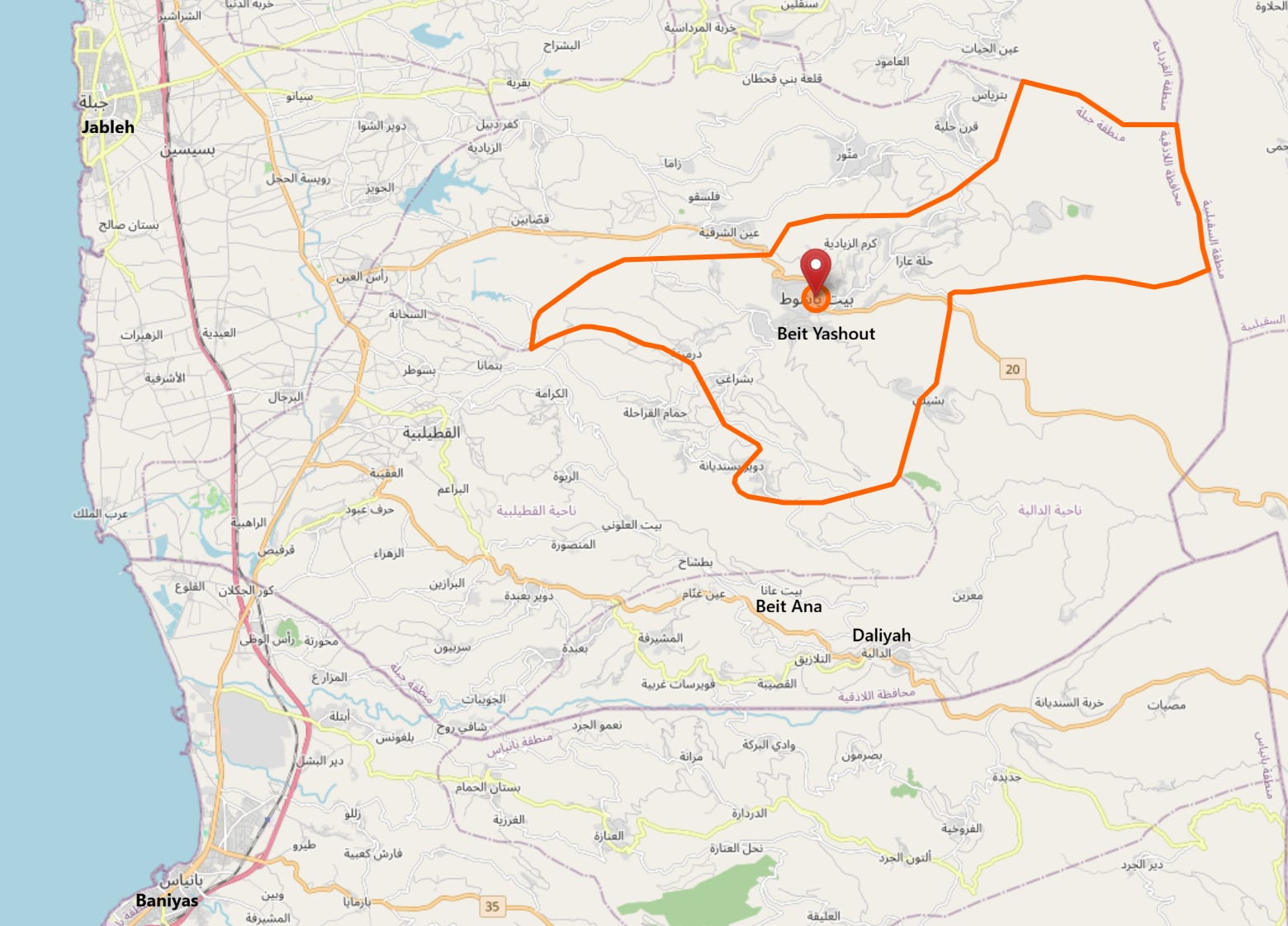
On the highway between Hama and Jableh lies the Beit Yashout subdistrict. This area has a significant ex-regime population, with more than half of the men here having served in regime forces, according to the mayor of Beit Yashout.58 Unlike other parts of Jableh’s countryside, like Qurfeis, the security official in Beit Yashout, known as Sheikh Yacub, had been highly cooperative with local leaders, thanks in large part to the support and cooperation from Beit Yashout’s mayor Maher Ibrahim. Maher is unique in that he was Syria’s only mayor who had left the Baath Party before the collapse of the regime. He is a revered local figure who had a history of confronting local shabiha and regime officials.59
This area saw several murders, kidnappings, and robberies in the first two months after the fall of Assad. This insecurity culminated in the January 13 murder of three farmers by government faction members operating out of the old 107th Brigade base near Ain Sharqiyah. The next day, a group of ex-regime insurgents captured a group of GSS members, executing two and holding seven hostage inside a remote Alawi shrine outside the town. Security forces were able to kill the insurgents and secure the hostages the next day. By February, however, the factions had been withdrawn from the 107th base just as they had from the Tartous countryside, leaving only an isolated GSS detachment in Beit Yashout town.
It was in this context, and in close proximity to Beit Ana, that insurgent networks rose up in Beit Yashout on March 6. Insurgents ambushed Sheikh Yacub and his men. “His unit was being killed and he called me asking for help,” Maher tells me, “So I started to call everyone I knew, and eventually I found someone who was working with the insurgents. I told him, ‘if you hurt him [Yacub] I will start an Alawi versus Alawi conflict.’” The insurgents ceased their attack and allowed Yacub and his surviving member to leave for Jableh unharmed. Large groups of insurgent fighters also stormed the 107th Brigade base, publishing videos early on March 7 from the entrance and interior. The videos, linked earlier in this report, show scores of armed men, many dressed in full military uniforms and others wearing civilian clothes, freely moving around the countryside.
Securing Yacub’s safety and the role of Maher as a trusted community interlocutor would prove pivotal two days later. On March 8, several factions were ordered by the Ministry of Defense to leave Jableh city and return to Hama. Among these were one brigade of the Sultan Suleiman Shah Division, also known as Amshat, whose members had committed massacres in and around Jableh the day prior. According to Maher, “Sheikh Yacub pressured these factions not to cause any problems, and when they arrived, I faced them with a smile and kindness and they began to calm down and realized the people here were ready to cooperate.” One media activist live streamed a video at the time of the Amshat faction entering Ain Sharqiyah, showing a calm meeting between the brigade commander and Maher and other local leaders. Both Maher and the activist confirmed that the factions committed no violations while passing through the area back to Hama.
Maher Ibrahim and local residents speak with an Amshat commander as his unit passes through Beit Yashout on March 8.
Bahluliyah Subdistrict
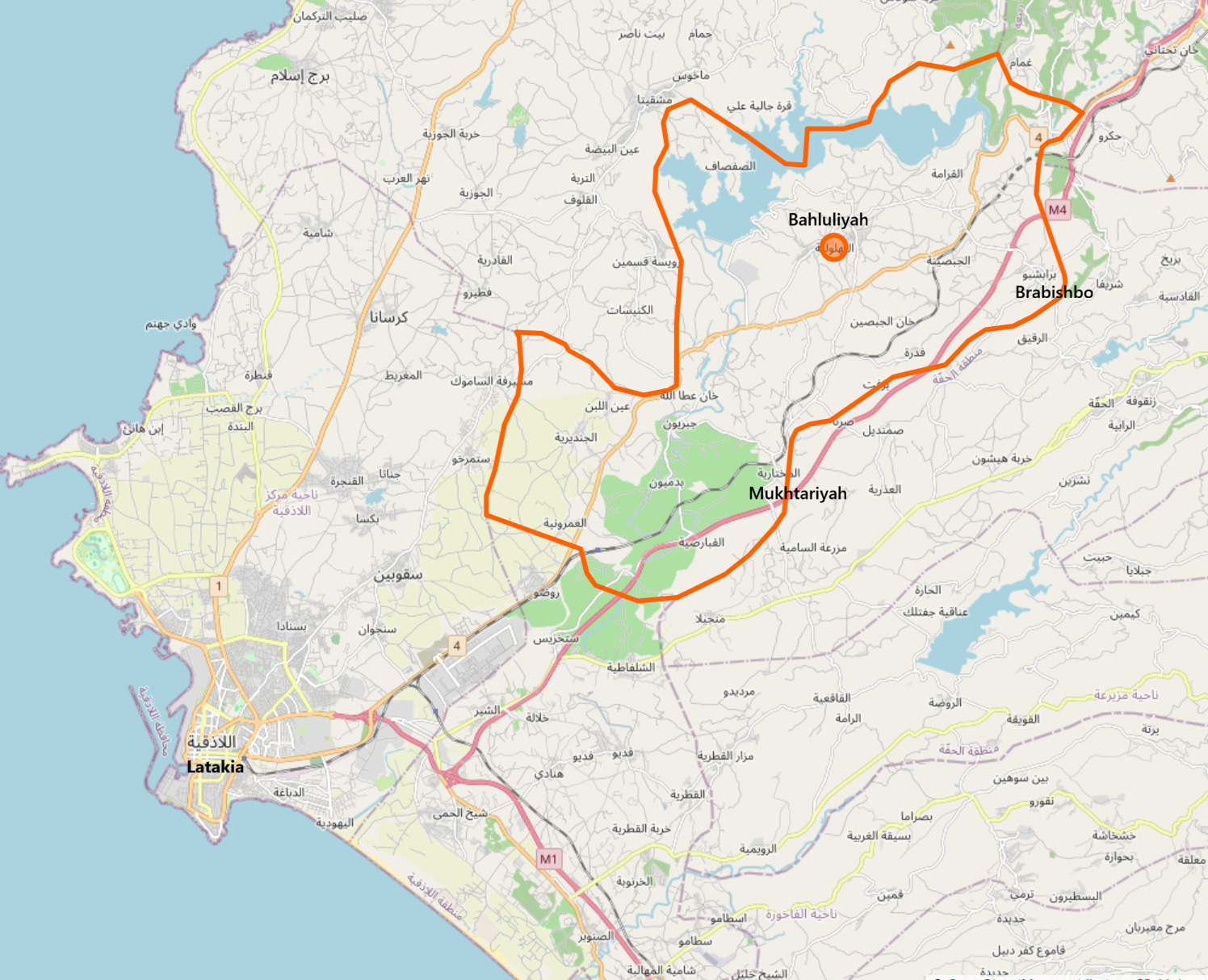
Residing on the border between Sunni north and Alawi south of Latakia governorate sits the Bahluliyah subdistrict. The area has had a unique experience since December 8, with significant trust building steps taken by both security officials and the local community, as I have previously profiled.
Trust Building in Rural Latakia

“Four of my children were burned to death by the Assad regime.” Abu Hassan recounts his losses with a nearly steady voice as we sip tea in Bahluliyah’s central cafe. “Thousands of dead bodies are sti…
In Bahluliyah there was no local support for the insurgency and the GSS office was not attacked, while terrified locals remained in their homes. Similar to Beit Yashout and Khirbet Maazah, the survival of the GSS here and the close ties they had built with locals would prove crucial for protecting the area over the coming days, in contrast with several nearby areas whose GSS detachments were wiped out by insurgents.
On March 7, pro-government armed groups began entering the region via the M4 highway from Idlib. A small group of armed men from one of these convoys turned north to Bahluliyah, encountering a local Alawi family driving on the outskirts of the towns and killing all four people. A local Alawi interlocutor quickly called the GSS office and, “Within 12 minutes they had sent 14 trucks to the main road and expelled the faction from the area,” he told me.60
The situation was very different further down the highway. Early on the morning of March 7, Alawi insurgents attacked the GSS checkpoint overlooking the highway outside the town of Mukhtariyah, which sits just outside the Bahluliyah subdistrict. This attack was reported by the COI and confirmed to me by local Alawi activists.61 The insurgents killed all 30 GSS members in the village.62 Later that day, armed factions entered Mukhtariyah and killed between 120 and 240 Alawi civilians, mostly men.
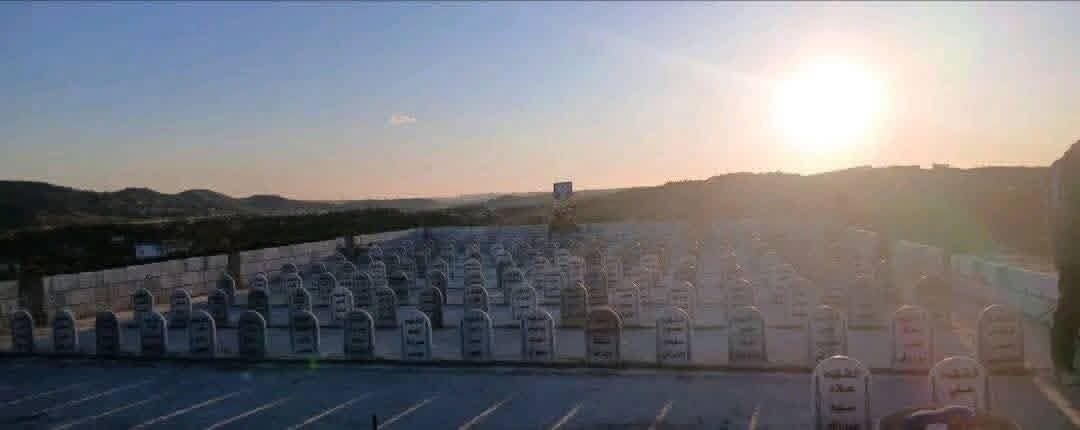
Over March 7 and 8, two armed groups also entered the nearby village of Brabishbo, which sits on the edge of the Bahluliyah subdistrict just east of the M4. According to a local who later led aid convoys to these towns after the massacres, the first two factions that entered Brabishbo on March 7 and 8, “were polite, telling the residents that they had confirmed there were no insurgents or threats and passing out their phone numbers in case any problems occurred.” This narrative was shared by a resident I spoke with in March 2025, who specified that the first group to enter was from Faylaq al-Sham and was respectful and professional when they searched the town. When they left, the commander gave everyone his phone number and said to call him if there were any issues.
However, on March 9 a third armed group entered the town and began killing residents and looting homes. Residents quickly called the numbers provided by Faylaq al-Sham, who then returned and forced out the third faction, but not before more than 30 Alawi civilians had been killed.63 Faylaq al-Sham units remained in the Bahluliyah and Haffeh regions after March, where they had a widely positive reputation. Following the March 9 attack on Brabishbo, the GSS expanded its checkpoints along the highway, preventing any armed groups from entering villages, according to locals.
Footnotes
See my previous reporting for a more detailed look at the strengths and weaknesses of some of these investigations.
Insurgents in Sanobar attacked the nearby military camp from within the town, according to two Alawi activists I met with in Jableh. The COI investigation reported the same: “The residents heard constant sounds of shooting from the camp in the lead up to the 7 March attacks, including at night. Shooting from houses in the town was also reported during the evening of 6 March.“ - COI report page 30.
Insurgent attacks targeting government positions in Mukhtariyah were reported by SCM (page 14) and COI (page 34). See also the “Bahluliyah Area” case study.
Insurgent attacks across Jableh city and its countryside are widely documented, including by journalist Loubna Mrie, who profiled one of the insurgents, writing that on March 6 he, “and others had mounted fierce resistance … gunfire had echoed into the night, and a number of police had been killed.” According to SCM, “By 4:00 PM on 6 March, military confrontations had reached Jableh city. Within hours, military groups linked to the former regime managed to seize control of the city’s northern and eastern neighborhoods. With the storming of the city’s southern neighborhoods, these groups carried out sectarian killings against the Sunni component. When military convoys from the General Security and Ministry of Defense, accompanied by military factions and local militias, entered to regain control, some of these forces committed widespread violations, including killings and looting, targeting all communities, both Sunnis and Alawites.” (page 13). COI reports similar dynamics (pages 11-12).
Insurgent attacks targeting government positions in Da’atour were reported by SCM (page 14) and COI (page 11).
See case study.
“Within a short period, most security forces in Tartus, Qadmous, Safita, Dreikish, Sheikh Badr and Baniyas found themselves besieged,” - COI page 11; “The Commission’s investigations showed that PFGF fighters shot at or near hospitals in Jablah, Baniyas, and the Tishrine University hospital and a blood bank in Latakia",” - COI page 12. See also the Baniyas case study.
See each case study for more details.
See case study.
See case study.
See for example: “‘“we are from Idlib, we are here to kill you, you killed us during Hafiz and Bashar’s rule.’” - COI page 31; “One man who introduced himself as from ‘al-Sharaa’s army’ reportedly told a witness: ‘you are Alawi, you hit us in 2012 in the beginning of the events, now we hit you. You killed us during the war, now we kill you.’” – COI page 31; “One victim described how, after her home was looted, one alleged “Amshat” member told her: ‘Alawis, you are kuffar, and you attacked us in 2011 and threw barrel bombs on us.’” - COI page 29; see also the Baniyas case study.
A friend whose family lives in Beit Ana was told directly by his relatives that insurgents entered the town with trucks full of guns, calling on all the men and boys to join them, and that, “even some college students took up arms.”
See COI page 10; Interview with media activists from Daliyah and Beit Yashout, September 2025.
The one notable exception was the lack of any insurgent movement in the Alawi areas north of the M4 highway in Latakia. These communities lacked the institutional connection to the Assad regime. Removed from the influence of ex-regime officers and shabiha, they had also enjoyed better relations with security officials in the first months after Assad’s fall. These factors combined to create little opening for insurgent recruitment, and the areas remained largely peaceful throughout March.
COI page 11.
See each case study. Also as reported by SCM, “The attacks were launched from three axes: the eastern mountains of Latakia, rural Jableh, and the vicinity of Tartous. The groups targeted police stations, checkpoints, and cut the Latakia-Jableh-Baniyas main road, concurrently with attacks on the Naval Forces Command, the Naval College near Jableh, the Criminal Security branches in Latakia and Jableh, Al-Qardaha Regional Command, and Jableh National Hospital, taking full control of them. They also cut the Duraikeish Road, Al-Qastal-Latakia Road, the Beit Yashout Road, and Satamu Military Airport, in addition to seizing control of Tartous port checkpoints,” page 13.
COI page 11-12
See for example a widely shared Facebook post on March 6 claiming that a group of government fighters were besieged in Qardaha and Qabu and calling on anyone to come rescue them. Pro-government forces would commit widescale killings in Qabu the next morning.
See case studies.
An investigation by Al-Jazeera Arabic, based on allegedly hacked and recovered electronic records by a Syrian named “Akif” goes further, claiming that the Russian military command played a direct role in coordinating the uprising through their old Syrian militia proxy networks.
This dynamic was reported by multiple Alawi and Christian activists, security officials, and an ex-regime officer I spoke with over the course of 2025.
These claims were widespread across Facebook in the days leading up to March 6, and many Alawi residents of rural Latakia and Tartous that I spoke with in the months afterward recalled insurgents using these claims to recruit supporters.
Interview with Alawi mayor in western Hama, February 2026.
See for example a series of Facebook posts from the Bahluliyah region on March 8, 9, and 10 which claim that GSS units were expelling criminal factions only for other groups to return after the GSS moved to another town. The inadequate number of GSS personnel has been a common compliant by both locals and security officials throughout 2025.
SCM reported on the targeting of economic centers in Baniyas: “In the Al-Qusour neighborhood of Baniyas City, a witness reported that prominent economic establishments in the neighborhood were subjected to organized looting and destruction. They explained that armed groups, and in some cases with the participation of General Security elements, smashed shop locks, followed by the arrival of civilians and small trucks, that loaded goods and contents. The witness also reported that all shops containing valuable goods, such as car and motorcycle showrooms, were looted and destroyed.” - SCM page 21. See also the Baniyas case study.
COI page 31.
Interview with activist in Sheikh Badr, May 2025.
Interview with retired regime officer who had supported regime defectors during the war, Latakia, July 2025.
Interview with security official based in eastern Sheikh Badr who was kidnapped by insurgents from Wadi Ayoun, February 2026.
Based on personal observations in February 2025 and interviews with residents and security officials throughout 2025.
Interview with local activist in Qamsiyah, February 2025 and May 2025; Interview with local activist in Sheikh Badr, May 2025; Interview with local security officials, September 2025 and February 2026; Interview with mukhtar in Brummanet al-Mashayekh, February 2026.
The specific details of the insurgency and background of ex-regime fighters comes from multiple rounds of interviews with three Ismaili activists working on civil peace initiatives in the district since December 2024, an Alawi media activist, two Alawi mukhtars, an Alawi teacher, and three local security officials.
Interview, Qadmus, May 2025.
Interview, Qadmus, May 2025.
In 2005, Alawi shabiha from the Qadmus countryside stormed Qadmus, burning Ismaili shops and triggering a military occupation that lasted several days. This history has not been forgotten, and lingering hatred between the Ismaili and Alawis remains. See Nabil Mohammad’s “‘من حكاية بلدة سورية اسمها ‘القدموس”.
Interview, Qadmus, July 2025.
Interview with local activist who worked in the affected towns after March, November 2025.
The information in this case study is based on interviews with two residents of Khirbet Maazah who work as civil peace activists in Tartous, conducted throughout the summer and fall of 2025.
The information in this case study is based on several interviews with “Abu Ahmed” (not his real name), a founding member of the Dreikish Civil Peace Committee, several youth activists from the countryside, and the Dreikish District Director Abu Zein, conducted throughout the fall of 2025.
I visited Bayda in February 2025 and met with some survivors of the 2013 massacre. Twelve years later, families were still living in burnt-out homes, sleeping on broken cots under ash-caked ceilings. The poverty and destitution in the village was evident everywhere, and certainly played a role in severity of the violations committed in the Qusour neighborhood in March. On the 2011 and 2013 massacres, see: Khaled Oweis, “Syria army attacks Banias, raising sectarian tension,” Reuters, 7 May 2011; Hugh Macleod and Annasofie Flamand, “Syrian army ‘cracking’ amid crackdown,” al-Jazeera, 11 June 2011; “‘No One’s Left’ Summary Executions by Syrian Forces in al-Bayda and Baniyas,” Human Rights Watch, 13 September 2013.
In explaining how he has learned so much, he once told me, “I am Christian, so everyone trusts me and sees me as a friend. This means they tell me things they don’t tell anyone else, the horrible things they think about each other. I have had Alawites show me videos from Bayda and Ras al-Naba that no one has seen before, horrific videos of the murders they committed, and I have had Sunnis show me videos of the murders and crimes they did here on March 7.”
See also COI report page 35.
Interview, Baniyas, May 2025.
Interview with Christian activist, Baniyas, November 2025.
See also accounts of this in: Helene Sallon, “In Baniyas, Syria, a Sunni man who saved Alawites from a massacre speaks: ‘We acted out of simple humanity’,” LeMonde, 17 March 2025.
There are conflicting narratives about when exactly and why Ayrout intervened. Some suggest that he was ordered or encouraged to by more senior officials once the extent of the massacres and violations was realized, others say that he intervened after being pressured by some local Sunni sheikhs who opposed the violence.
COI report page 36-37.
“By four o’clock in the afternoon local time, armed confrontations reached Jableh. Within hours, the attacking forces managed to take control of the city’s northern and eastern neighborhoods, where both Alawites and Sunnis live, two sources from the city told Syria Direct.“ - Walid al-Nofal, “As Jableh picks up the pieces, can residents overcome ‘sectarian tensions’?,” Syria Direct, 12 March 2025; See also COI report page 11-12.
COI report page 11-12.
COI report page 12.
COI report page 11.
For example, one viral post on a Jableh Facebook page says, “A call to our brothers in the city of Jableh, specifically the Al-Fayadh area of Jableh, near the Umm Burghul Bridge: We need your help, men!”
Walid al-Nofal, “As Jableh picks up the pieces, can residents overcome ‘sectarian tensions’?,” Syria Direct, 12 March 2025.
SCM report page 13; Walid al-Nofal, “As Jableh picks up the pieces, can residents overcome ‘sectarian tensions’?,” Syria Direct, 12 March 2025; Hossam Jablawi, “تفاصيل ما حدث في جبلة بعد هجوم فلول النظام.. سرقات واسعة وإحراق للممتلكات,” Syria TV, 22 March 2025.
COI report page 29.
Interview, Jableh, September 2025.
Interview with Maher Ibrahim, September 2025.
The information in this case study is based on testimonies from Maher Ibrahim and a local media activist I met with in September and November 2025. For a partial interview trasncript, including Maher’s biography, see here.
Interview, Bahluliyah, September 2025.
"During the evening of 6 March, shooting erupted near a checkpoint set up under Mokhtariyeh bridge and continued until the early hours of 7 March.” - COI page 34.
According to an aid worker from Bahluliyah who worked in Mukhtariyah and Brabishbo in the months after the massacres, interviewed on September 2025, December 2025, and February 2026.
According to the aid worker from Bahluliyah, some members of the third faction actively protected residents of Brabishbo while other members from their unit conducted killings. This included telling residents to hide when then entered homes, and telling other members of their unit that, “everyone in this house is dead,” or, “there is no one in this home.”
Been bookmarked for months and just got around to reading it. Extraordinary report!
This is fantastic! Exactly what's been missing from the narrative & public reports, and what I've been wanting hoping & waiting for someone to address. Thank you Gregory.