

The experiences of many Syrian communities in the early post-Assad transition period were heavily shaped by individuals who stepped forward to build a new path. In Alawi areas, these individual efforts by both local residents and opposition fighters were crucial for shaping each town’s trajectory. In Hama’s Masyaf district it was no different. The experiences of one town, Jubb Ramleh, further highlight the role that personal connections and early communication lines played as a basis for relationship building between locals and the new security officials. These relationships were crucial for preventing widescale violence in this sensitive region, but are incapable of addressing the more dangerous social and economic crises now impacting the people.
Khaled’s phone buzzed the day Aleppo was liberated. On the other end was an old friend from college who he had not seen since the revolution began in 2011. After college, Khaled (not his real name), an Alawi from rural Masyaf, had gone on to work as a computer engineer at a local office of a global telecommunications company. His friend had joined al-Qaeda’s Syrian branch, Jabhat al-Nusra. In 2014, amid widespread anger by Syrian government employees over stagnating wages, Khaled posted a single line on Facebook in which he indirectly called President Bashar al-Assad a “dog.” He would spend the next ten years wanted by the regime, forced to smuggle himself through checkpoints any time he left his town. Meanwhile, his friend was rising through Nusra’s ranks, eventually becoming a respected commander in the group’s final iteration, Hayat Tahrir al-Sham.
With the unexpected ease of HTS’s advance into Aleppo city on November 29, the group realized they had a chance to seize far more territory than they initially expected. HTS leaders began contacting important minority communities in Hama, quickly identifying HTS officers who had personal or familial contacts in these towns. In Salamiyah, for example, HTS political officers quickly negotiated a deal with the head of the Syrian Ismaili Council, but HTS field commanders from rural Salamiyah were also calling their families and negotiating directly with town mayors to ensure there would be no fighting.
The same was happening in Masyaf. At the same time Khaled was contacted in his town of Jubb Ramleh, two of his friends in nearby Salhab and Muhrahdeh received messages from their own childhood friends who had gone on to join HTS. Before HTS had even liberated Hama city, the group was already negotiating the surrender of the Masyaf countryside, the regime’s manpower basin in Hama governorate. Khaled and the other men initially contacted then messaged men in other villages who they knew held similarly anti-Assad views and could be trusted to help prepare the ground for the rebels’ entrance. A spiderweb of communication rapidly grew across dozens of towns and villages in Masyaf.
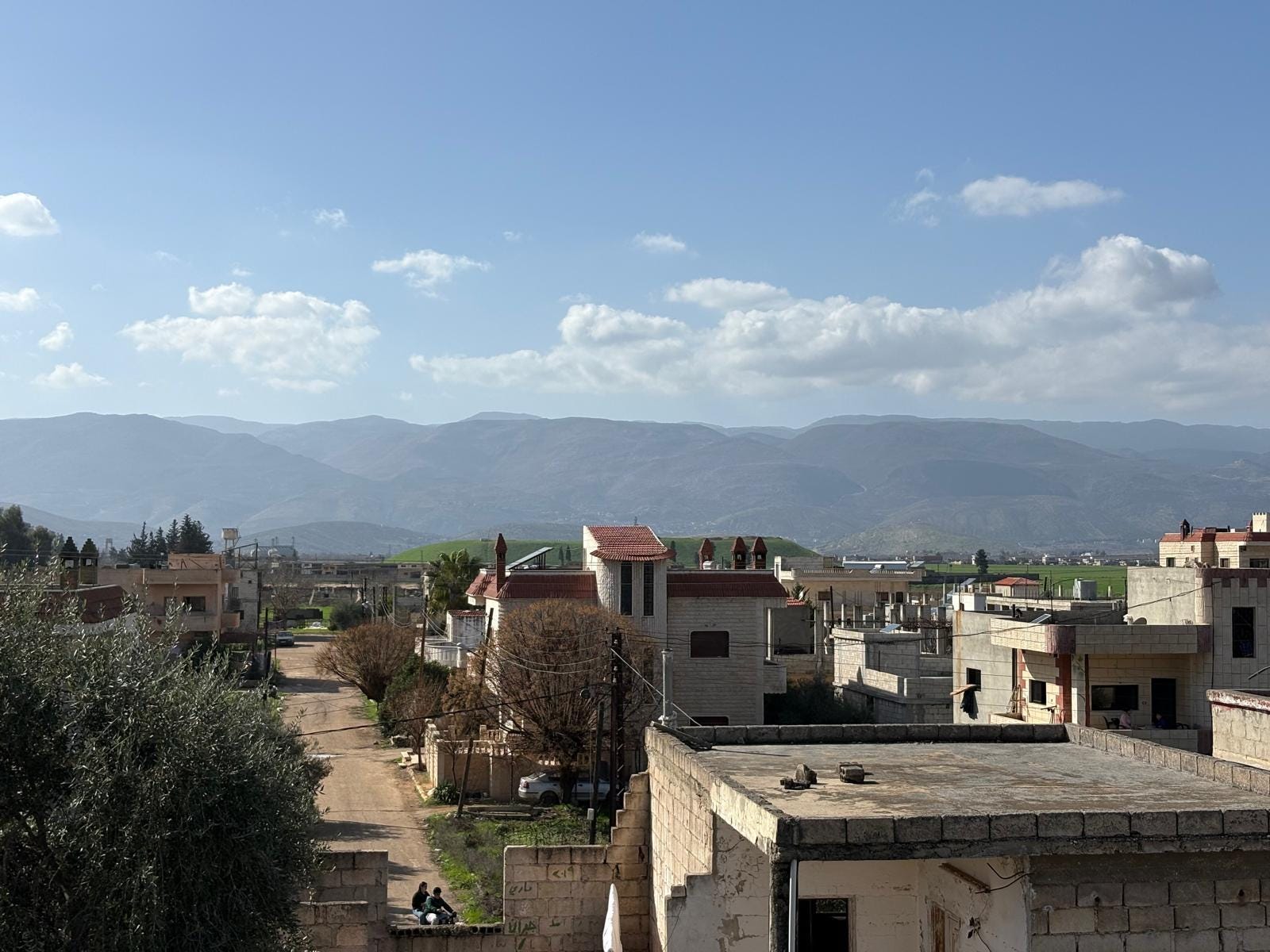
On December 8, at 7am, Khaled’s old friend entered Jubb Ramleh. Despite Khaled’s best efforts, most of the town’s residents had fled to the nearby mountains, fearing the Sunni rebel fighters would massacre them. Khaled and a small group of men stayed behind, however, welcoming the HTS unit and sending videos of themselves with the armed men to the rest of the townspeople to try and assuage them of their fears. After a while the unit moved on, heading towards the city of Masyaf, and some residents returned.
At 9:30am another armed rebel faction entered the town. Khaled did not know them, but a larger group of residents gathered to welcome them this time. According to Khaled, the faction questioned whether Jubb Ramleh was a Sunni or Alawi town, and then executed one of the men who had welcomed their entrance. The faction then left for Masyaf.
Community Initiatives in the State’s Absence
“When the regime collapsed, everything collapsed,” Khaled tells me over tea on his rooftop. There were no services, salaries, or basic goods, even the bakery had stopped receiving flour. Despite the murder committed by the faction, Khaled knew he had to try and keep these basic necessities moving.
The Masyaf countryside became synonymous with pro-regime militias during the war, resulting in widespread demonization of the entire area by the Syrian opposition. The city of Masyaf is itself majority Ismaili with Sunni, Christian, and Alawi communities and had risen up against Assad in 2011. But the countryside is nearly entirely Alawi, and it was from these villages that the regime drew both soldiers and militia fighters. Warlordism grew rampant in rural Masyaf, fueled by wealthy regime-linked businessmen and a few prominent families who turned their wealth and regime-connections into networks of armed groups. These groups were used extensively in military operations against the opposition across the country. But as the regime recaptured most of the country and the availability of new Sunni communities to plunder evaporated, these militias turned inward. Beginning around 2018, these armed networks became increasingly predatory against Alawis in the Masyaf countryside, kidnapping, murdering, and stealing from the Alawi and Sunni communities alike.
Jubb Ramleh had long stood apart from this dynamic. Unlike nearby towns like Asilah, Salhab, and Rabia, few of Jubb Ramleh’s men joined regime militias. As the capital of Masyaf’s largest subdistrict, the town has a high education rate and more expansive government employment. Of the 7,500 residents of the town, roughly 70% worked in government jobs, with less than 11% serving in the military. This difference is starkly reflected in the publicly reported funeral records of the towns during the first years of the war. Between 2011 and 2013, for example, only 15 men from Jubb Ramleh died while fighting in the regime’s army, while in the same period 39 men from Asilah and 161 men from Rabiah were killed in the regime’s ranks.
The collapse of the regime’s security services on December 8 meant that thousands of men across Masyaf had lost their paychecks overnight. Subsequent government restructuring campaigns in early 2025 saw waves of municipal and national-level employees fired from their jobs. Due to the over-representation of Alawis among government agencies, these campaigns had an disproportionate impact on Alawis. The combined effect was a sudden, massive economic collapse within Alawi communities. In Jubb Ramleh, only around 10% of the town remains employed in the government today, and there is little to no natural local economy for newly unemployed college graduates to move into.
Khaled urged the town’s residents to return from the mountains throughout December 2024. At the same time, he established a small council in the town in order to address this sudden crisis, encouraging other towns to do the same. These councils worked to provide food, medicine, and flour to their communities, using both local fundraisers and personal funds from the council members themselves. Many of the men have gone into debt trying to support these initiatives, borrowing from wealthy Alawi businessmen. “When you form something like this, a small council to manage daily matters, you need resources and so it’s a huge problem that money is not available,” explains Khaled.
For seven months these councils and local charities raised money and supported local families. Economic stress was worsened by the arrival of families from the village who had been living in the military housing in Damascus and Homs. Now unemployed and facing uncertain stability in these housing blocks technically owned by the government, many of these families have returned to their villages across the coast. But by mid-summer the money had run out.
In mid-February, these informal community councils merged with the original network of interlocutors who had communicated with HTS prior to the group’s entry to the region. What emerged came to call itself the Higher Alawi Islamic Council of Hama and Homs. The organization’s initial focus was on filling the services gap left by the collapse of the regime, but it was also able to leverage the individuals’ ties to security officers to serve as community interlocutors. Khaled explains the philosophy behind the council:
“There is a proverb: ‘a small problem needs a small guy to resolve it, a big problem needs a big guy.’ All the other sects have a central structure to solve these matters, except the Alawis. So how do you collect all of the Alawis without a head religious man? You begin calling the friends from university or work, and you form a network. So, we created a 50-person network in Hama and Homs. We had the first meeting in Salhab with the knowledge of the new government in January 2025. We wanted to understand the new government and its principles. Previously we knew nothing about these rebel groups, how they lived or perceived us. All people were afraid of the new government. We wanted to create a bridge between the government and the people. The main goal was to return services.”
The council continues working today, though in a highly decentralized manner. Each member works individually within his community, with the council forms a sort of support network he can refer to if needed.
Building Security out of Chaos
The trust the council’s members had established with officials early on, as well as the clean backgrounds of Khaled and the other local interlocutors, enabled the men to engage in a more collaborative dynamic with security officials. Khaled organized weapon handovers and the peaceful surrender of wanted men, avoiding security raids like those seen in rural Homs which at that time frequently resulted in deaths and violations against Alawi residents.
When Alawi insurgents rose up in the coast on March 6, Masyaf remained largely peaceful. “The Alawis in the coast and Hama are a different class,” explains Khaled, “We knew nothing about the insurgency in the coast, because they did not trust us.” Insurgents had not expanded or activated their networks beyond the most westward edge of Masyaf, around Wadi Ayoun, Resafa, and Salhab, thus leaving security forces in the rest of Masyaf relatively untouched. Yet the insurgency undermined the progress Masyaf’s leaders had made with local officials, spurring renewed distrust towards men like Khaled. Khaled and the council were barely able to prevent new security raids in their towns in the days after, but intense dialogue eventually prevailed.
The success of this dialogue was rooted in the network’s attitdues towards security officials in the preceding months. Khaled had engaged HTS officers early on, encouraging them to establish a security point in the town’s former police station. “They brought a force and began doing patrols and dealing with criminals,” recalls Khaled:
“They gradually expanded security from here, but the turning point came when they brought in defected police officers in July and handed over control of the station to them. They were very relaxed and easy to work with, and the mindset here shifted from a military one to a police mindset.”
Many communities in the Masyaf region were similarly eager to have HTS establish security positions in the countryside, an attitude that was not as common at this time in rural Tartous or Latakia. For the residents in Masyaf, these police stations and checkpoints were seen as a form of protection from extremist and criminal elements of the security forces and from local communities. Due to Masyaf’s reputation for hardcore Assadist militias and its proximity to strategic areas of Hama and Idlib, many of the most hardened opposition factions were initially sent to the region on December 8. Among these were Ansar Tawheed and the Turkistani Islamic Party (TIP). It was likely the former of these that executed the man in Jubb Ramleh on December 8.
According to revolutionary activists from Masyaf city who I spoke with last summer, it was these two factions which immediately caused problems in the area. “They entered the city expecting us all to be shabiha,” said one man, an Ismaili media activist who had previously worked with the Free Syrian Army, “we had to sit down with them and show them videos of us protesting in 2011 to prove to them that we were with the revolution.” Only then did the factions begin to relax.
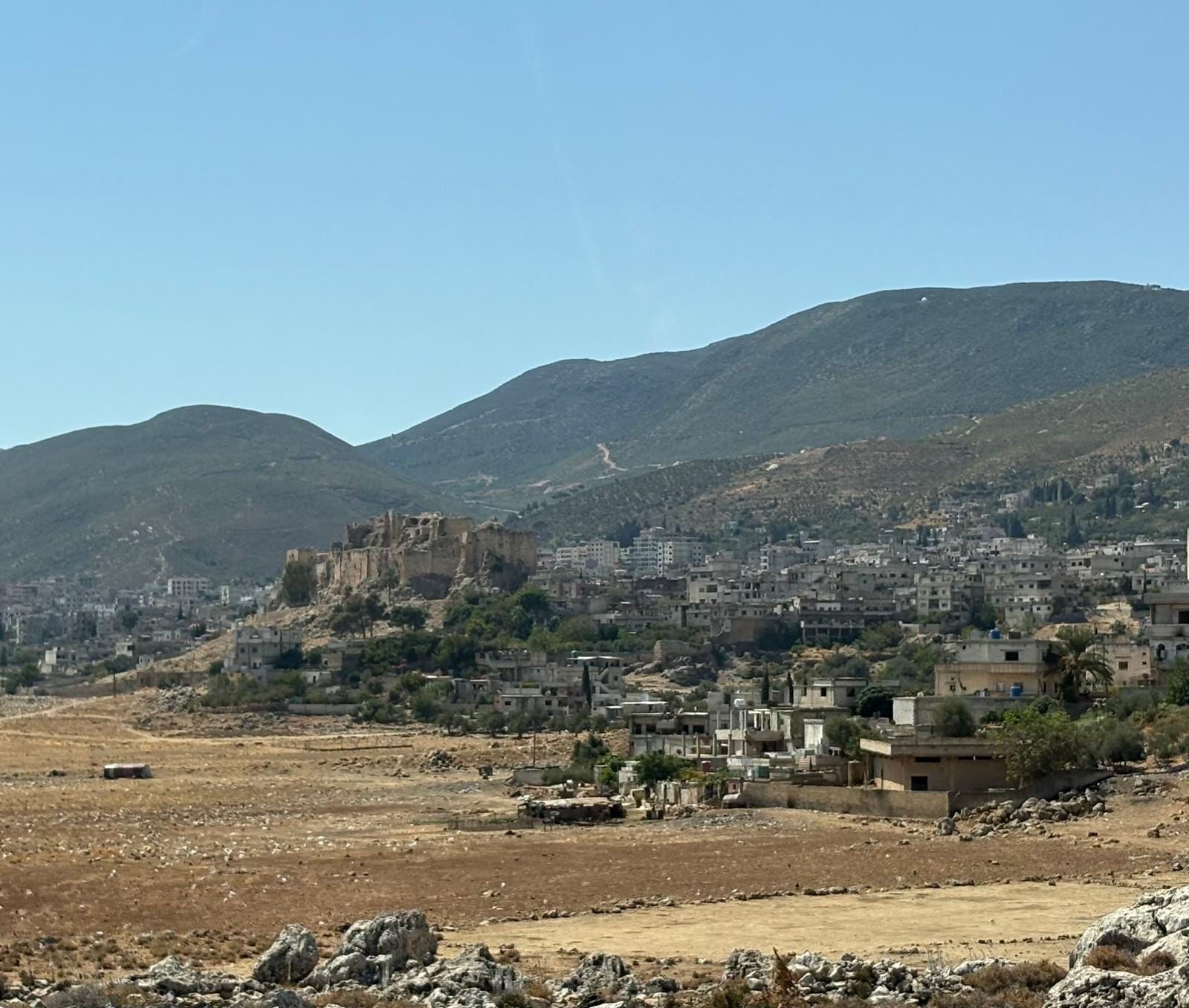
Ansar Tawheed was then assigned to help oversee security in the Masyaf region, working alongside units belonging to HTS and the local Free Syrian Army faction Jaish al-Izza. It was in this context that Khaled and other local notables had called on HTS specifically to erect new security points, hoping the group would help keep out the more extremist Ansar Tawheed while also addressing intercommunal criminality coming from some of the nearby Sunni towns. Jaish al-Izza was soon assigned as the primary army faction in the area, and its leader, Brigadier Jamil Saleh, has built a close relationship with the Alawi communities.
While Ansar Tawheed was withdrawn from Masyaf by the spring of 2025, the inter-communal violence remained. Revenge attacks, both directly against regime criminals but also against perceived communal culpability, became an increasing problem. “Before the regime fell it was a complete government,” says Khaled, “it had state branches, security and military, and Baath employees. Now having been in any of these jobs has become an accusation.” As the security forces in Masyaf improved and violations from the government units ended, it was the Sunni communities in rural Hama which became the primary threat to Masyaf’s villages. “They are threatening the farmers, sometimes using weapons other times going out and damaging farming equipment or bringing shepherds to graze on the Alawi farms,” Khaled explains.
Most of the tensions have come from one of the few Sunni villages in Masyaf district, Dimo. Dimo is less than a third of a mile east of Jubb Ramleh. Most of the tensions between the towns have centered around agricultural land and grazing rights. However, there have been incidents of theft, harassment, and murder. The most significant violence in recent months came on December 29, when two Alawi farm workers were killed near Jubb Ramleh. Residents accuse men in Dimo of being behind the murders. As we spoke that afternoon, Khaled received a phone call from a local shop owner. Two men from Dimo had shoplifted some goods and fled on motorbike.
An Uncertain Future
Khaled’s collaborative mentality is borne from years of opposing the Assad regime; dodging the compulsory conscription and hiding from arrest warrants for more than 10 years. His focus has been on rebuilding his community and working with the state, an approach which necessitates prioritizing civil peace over justice. Reflecting on the December 8 murder by the opposition faction, Khaled says, through a pained face, “We have to consider this a natural part of these kinds of huge transitions if we want to move forward and build something.” Yet the revenge killings that continued after December 2024 have undermined trust from the Alawi community for the new authorities, and the ongoing economic collapse has fueled perceptions of intentional marginalization of the Alawi countryside.
According to Khaled, the December 29 killings were a type of thievery against farmers. However, he is optimistic that the new Security Director for Masyaf will be able to improve security. Masyaf District has undergone a series of leadership changes since December 8 which have had serious impacts on security and trust building among all sects. The HTS officer who knew Khaled from before the war served as the military official for the district until late Spring 2025 and did a good job establishing basic security services. However, as part of the new government’s restructuring he was later replaced by a new District Director, an administrative official named Muhammad Taraa, who quickly began consolidating power in the district. Taraa sidelined and at times directly attacked the Sunni and Ismaili community while surrounding himself with wealthy Alawi shabiha, according to several activists from Masyaf city. At one point Taraa even ordered the imprisonment of the city’s most prominent Ismaili and Sunni businessmen over a verbal dispute.
By late 2025 Taraa was removed from his position and a new District Director and Security Director was assigned to the district. Both men quickly began to rebuild relations with each of Masyaf’s varied communities. The Security Director, a defector from Rastan, had served for nearly a year in Salamiyah, where he had a strong track record of working with that district’s Sunni, Ismaili, and Alawi communities and building effective local dispute resolution systems.
“We met with the director and introduced ourselves,” says Khaled, “He is a good guy on security issues and responsive.” When the double murder occurred on December 29, Khaled and his council met with Security Director to explain the problems the farmers were facing. The General Security subsequently established a series of patrols and new checkpoints in the area. “Maybe in 6 months the security situation will be settled and the social problems between the sects will be better,” Khaled hopes, “But the major problem of the economy remains and this will continue to exacerbate the social situations.”
Despite the security improvements, little has been done to address the roots of the inter-communal conflict in the region. Locals have held meetings and attempted dialogue sessions between village representatives, all supported by and coordinated through the new District Director. He had previously been in charge of engaging with and supporting Hama’s Alawi community from the governor’s office, and through this work had already built relations with many of Masyaf’s Alawi leaders, including Khaled. “He is a very good man,” Khaled says, “he engages closely with all communities and holds many meetings.” Yet there has been no recent engagement from the governor’s office or the Political Affairs Directorate, both of which would have more weight within the Sunni towns. Nor has there been any support from national or international NGOs.
Meanwhile, the economic crisis has become the dominant issue in the district. Khaled and his network have fostered close relationships with local security officials as well as some political leaders in Hama, but economic and service support to the area is still non-existent. Many activists and community leaders, like Khaled himself, have gone into debt in their attempts to fill the services gap left by the collapsed state and the absent INGOs. Debts are generally in the range of a few thousand dollars – nothing for the aid organizations that never arrived, but huge for communities where a government salary is less than $100 a month. Now the money lenders are threatening to take people like Khaled to court to get their money back.
Like every Alawi area I have visited since late 2025, Khaled and the residents of Jubb Ramleh believe their community has been intentionally marginalized by the new Syrian government. They see the lack of NGO activity and economic investment as a result of explicit orders by Damascus banning such work in Alawi areas. Yet this is the case across all of rural Syria, Sunni or Alawi. Just a few dozen miles north, in Idlib’s Jabal Zawiya region, scores of towns have been left to rebuild on their own. This area was the heart of Idlib’s revolutionaries, as Masyaf was for the regime, and yet its communities have also received no government or INGO support. When asked about this, government officials often point to the scale of economic and infrastructure crises facing the entire country. Their priorities, and those of international donors, are with the cities, the economic and social heart of Syria.
This reality does nothing to dissuade perceptions of abandonment and marginalization. For Alawis, it is just another indicator that they are not part of this new government. For many rural Sunnis, there is an unhappy acceptance of the countryside’s isolation. Every discussion about the lack of support ends with the phrase, “but we must be patient, the government has too many problems to address.” It remains to be seen how long this patience will last. Meanwhile, in rural Masyaf, there is only so much that the District and Security Directors can achieve on their own. Security can be improved through the efforts of the General Security forces, but this only addresses the symptoms of instability. Continued economic strife and unaddressed inter-communal grievances remain the heart of Masyaf’s fragile peace, and resolving these requires a holistic and unified approach – more than what Khaled can achieve on his own.
As I was reading this article I kept thinking about the new orgs & institutes that have been formed by diaspora Syrians who oppose the government — most of which *claim* to be advocates for Christians, Alawites, & minorities in general (with figures like Sally Obied working for them now). These groups, which I believe are funded by UAE & Israel & groups in western states, have been lobbying the US & EU to place sanctions back on Syria, to hurt the government, who they imply or outright claim are a threat to all minorities — totally ignoring the nuanced situations & intercommunal dynamics that you often right about.
And I kept thinking about how those groups, and what they advocate (sanctions) are taking the exact WRONG approach, because they aim to make the economic situation even harder for all Syrians, while claiming the problems lay in the Sunni religious ideology of the gov administration rather than focusing on the real issues, like economic dispair & transitional justice. I'd suggest to them to actually speak with people, as you have, but Im pretty sure they act in bad faith, and only want the government to fail, rather than actually improve anything.