

On January 30, 2026, a new integration deal was announced between the Syrian Transitional Government (STG) and the Syrian Democratic Forces (SDF). The deal follows two weeks of intense battles between the two sides, as STG units pushed the SDF back from the Euphrates River to two pockets of Kurdish towns along the Turkish border. These battles are a continuation of the breakdown of diplomatic talks between the two sides, which first saw the expulsion of SDF forces from Aleppo city earlier this month.
Sheikh Maqsoud and the Changing Course of SDF Integration

On January 10, forces of the transitional government in Damascus took full control control over Aleppo city for the first time since they had entered the area in November 2024. Since then, three neig…
The Sheikh Maqsoud operation was the STG’s third and by far its most limited military operation, largely relying on a few brigades from three divisions with units of two additional divisions playing an auxiliary role.
The northeast operation was the opposite, by the far the biggest and most complex military operation the STG has undertaken so far. The operation used units from nearly every single division in the army, most of which deployed multiple brigades across different frontlines. This short focuses on the military deployments of this two week battle, tracing where each division was present based on public self-reporting as well as the combat losses suffered by the STG. This is not a day-by-day timeline of the advances.
Combat Losses
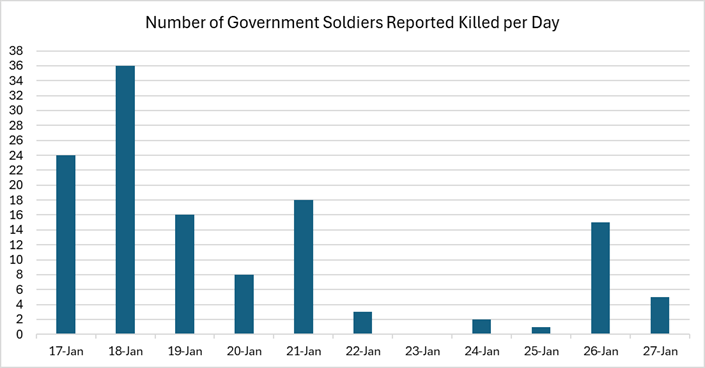
The STG lost at least 128 soldiers during the two weeks of fighting, with nearly all of those deaths occurring in the first five days. There were noticeable jumps in STG-reported deaths on both January 21 and January 26 amid continued advances by STG forces into Arab areas and SDF drone strikes and ambushes.
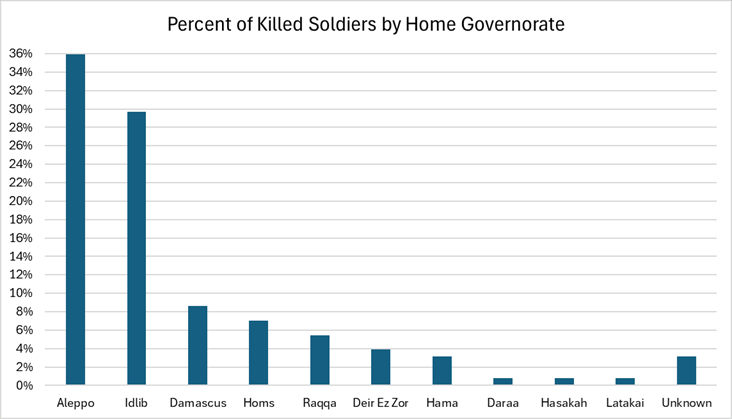
As with the Sheikh Maqsoud battle, most of the killed soldiers were from Aleppo and Idlib. However, reflecting the wider breadth of units involved in this operation, there were also significantly more deaths among men from Damascus and eastern Syria.
Unlike the Sheikh Maqsoud battle, the northeast battles have seen several senior STG officers killed or wounded. Mine clearance operations killed the commander of the 66th Division’s Engineering Regiment (أبو عمر حطلة) on January 19 and the chief of staff of the 76th Division’s Engineering Regiment (محمود خالد الأخن) on January 21. The commander of the 42nd Division’s Engineering Regiment (أبو مصعب شنان) was killed while clearing SDF tunnels in the Lafarge Plant on January 26.
The 82nd Division, consisting of the former Ansar Tawheed faction, lost three senior officers in an ambush during the initial push to Maskanah on January 17. This included the division’s Operations Commander (ابراهيم محمود زهرة ابو موسى) and the commander (ابو عبد الرحمن كفرعويد) and chief of staff (طه بسام منى) of the Infantry Brigade. The commander of a Commando Brigade (محمد خالد عز الدين حسين النعيمي) from an unknown division was killed on January 22 south of Kobani.
On January 17 a “military commander” in the 42nd Division (أبو عادل السلطاني) was killed during the battle for Tabqa. He had previously led the opposition Liwa al-Izza faction. On January 18 the commander of an unspecified unit in the 66th Division (جمعة جاسم الزين ابو بهاء) was killed and a battalion commander in the 52nd Division was wounded in the Euphrates river area.
The losses suffered by the STG paint a more nuanced picture to the collapse of the SDF during the first week of fighting. SDF units did not withdraw from their positions west of the Euphrates, putting up a substantial fight in Tabqa and Mansoura in particular. Instead, it seems to have been the defection of the Arab component of the SDF combined with the massive, coordinated military force brought to bear by the STG and the local Arab uprisings within SDF territory that combined to collapse the SDF’s military position.
Government Unit Deployment
The following section contains a map showing each division’s movement across the northeast beginning on January 17 followed by a write-up of each division’s known movements and the specific sub-units involved. All of this information is based on social media posts by unit members and community Facebook pages, often relying on matching pictured commanders to previously documented unit assignments.