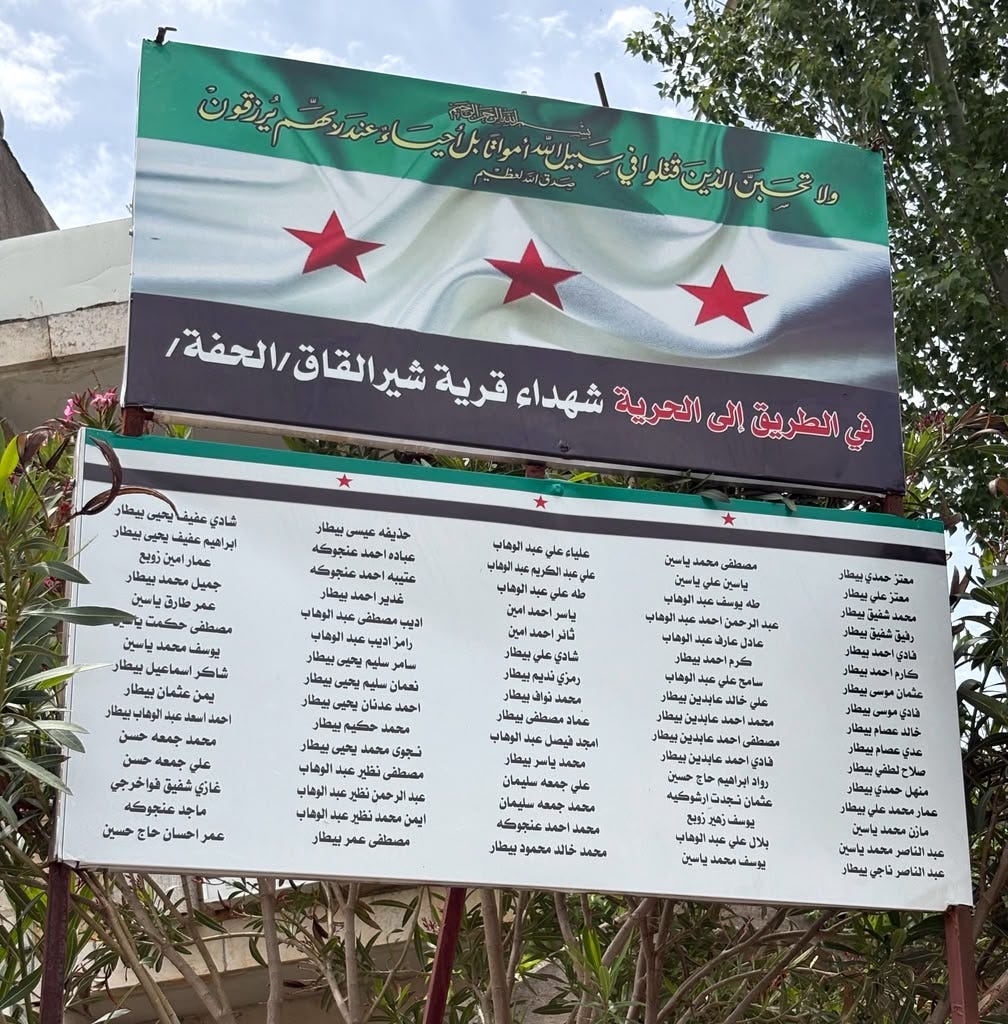
Grey clouds hang low over Haffeh two months after the fall of the Assad regime. A large green Syrian flag stands at the town’s entrance, though some shuttered businesses still bear the bright red paint of the regime’s flag. A steady rain has driven the few residents indoors. Men huddle around stoves trying to beat back the sharp mountain cold. Everyone eyes me carefully as I walk the streets, an obvious outsider in a town whose pain is still fresh.
Haffeh sits on a long, thin mountain plateau 30 minutes east of Latakia city. The M4 highway runs through the wide valley a few miles north. The famous Salah al-Din Castle rests across a steep valley to the southeast. The town and a handful of small villages clustered around it create a pocket of Sunni families in one of the most strategically important parts of Latakia governorate; a gateway to the low plains of Latakia city and access to the only road into the mountains overlooking northwestern Hama.
The town was the site of one of the first major battles in Latakia governorate – a brutal three-day siege followed by mass displacements, arbitrary detentions, and killings. The battle for Haffeh marked the end of the revolution’s short-lived hopes of reaching Latakia city, and was a key strategic victory for the regime. It also had long-lasting consequences for Sunnis elsewhere in the governorate whose families came from the town and now became frequent targets of regime arrests, as well as tearing apart the social fabric between Haffeh’s Sunnis and the neighboring Alawi communities.
Beginning a Revolution
As in Latakia City, residents began demonstrating in Haffeh at the very outset of the revolution. Many families in Haffeh had lost members to the regime’s anti-Muslim Brother campaigns in the 1980’s. According to one resident, there was no real Brotherhood movement in the city, and most of those targeted by the regime had no affiliation to the movement whatsoever, including a local Christian man detained by the regime’s intelligence. But the anti-MB operations went beyond arrests. Soldiers combing the city executed a dentist in his shop; a lawyer who had been advocating to end the state of emergency law was tracked down and killed on the streets. As a result, according to the resident, “people were waiting for any chance to protest.”
The first martyr rose on June 6, 2011. Abdul Qader al-Souseh, a middle-aged man from the village of Babinah just outside Haffeh, was shot to death by gunmen while working his farm. According to one relative, security forces seized Abdul Qader’s body and refused to hand it over to his family until they signed a testimony that he had been killed “by terrorists” and would not hold a funeral. That evening, hundreds of people marched through the streets of Haffeh holding Abdul Qader’s coffin and chanting for the downfall of the regime.
Weekly demonstrations continued inside the city for months. In May 2011, Assad appointed Major Geneal Muhamad Shaar as his new Minister of Interior. Shaar, a Sunni from Haffeh, contacted the families in the town and told them that if they contained their protests to the southern neighborhood no harm would come to them. Still, the revolutionaries did not trust the regime and began to arm themselves in the villages.
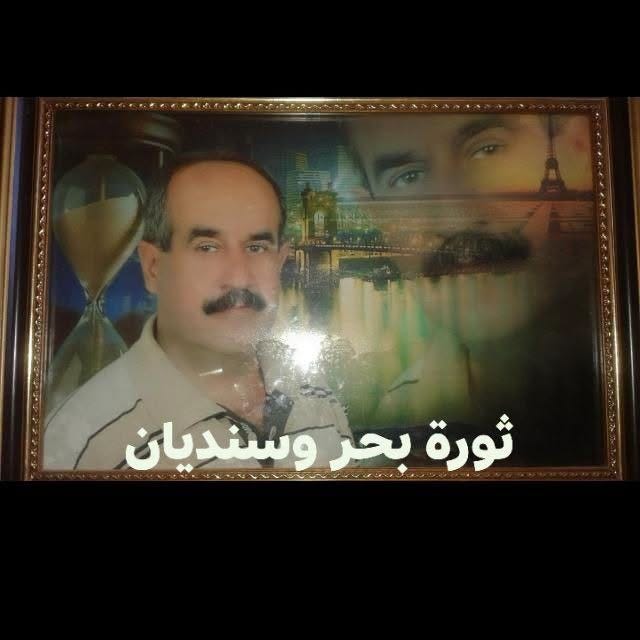
Despite Shaar’s promises, demonstrators quickly encountered problems with the regime’s security. Reem, a resident of Haffeh whose husband was killed while fighting for the FSA, recalls how at first the police and intelligence officers would take some protestors to the town’s police center and forces to write pledged to never protests again. However, things changed after the June 2011 attack on mukhabarat offices in Idlib’s Jisr Shoughur. The Military Intelligence took a more active role in detaining activists and many were transferred to far away prisons, including Sednaya, and were never heard from again.
The nearby Sunni villages thus became centers of revolutionary activity throughout 2011 and the first half of 2012. According to one Free Syrian Army fighter from Haffeh, regime forces attempted to enter some of the villages in 2011, triggering clashes with local armed groups. “The regime then knew they had weapons and stayed out.” At the same time, however, regime intelligence officers were organizing and arming the neighboring Alawi villages. Popular Committees and Baath Battalions units formed in the countryside, while on October 21, 2011, army units deployed into Haffeh for the first time.
A since-deleted video published on October 21, 2011 titled “Security forces and army vehicles deployed in Haffeh.”
This deployment came two months after the regime’s first major anti-revolutionary operation in the governorate. In August, regime army units backed by Navy ships stormed the besieged Southern Raml neighborhood in Latakia city. Opposition fighters and regime defectors fled the city, smuggling themselves into the Latakia mountains. These men helped bolster fledgling armed networks across northern Latakia. The battle reinforced Latakia revolutionaries’ belief in the necessity of arming themselves, and the new Raml arrivals played an important role in building the armed movement in Haffeh and in the mountain villages to the northwest.
Arming the revolution in Haffeh was a gradual and dangerous process. At first most men had to rely on old hunting rifles or individual weapons brought back by defectors. However, by early 2012 local groups secured a large shipment smuggled in from Turkey. According to Abdullah Qabarou, a former fighter and historian from Latakia, this shipment contained around 400 AK-47s, 200 Turkish NATO rifles, and 100 RPGs. A second shipment was prepared that spring. Revolutionary leaders contacted the nearby Alawi villages and struck a deal, “don’t touch the incoming shipment and we will leave you alone in the future.”
Yet, according to Qabarou, some informants tipped off regime officers. A battle broke out as each side attempted to secure the weapons, with revolutionary factions ultimately taking control. This battle coincided with an increased regime military deployment inside Haffeh. On April 11, 2012, the same day that three soldiers were reported killed in clashes in the Haffeh countryside, units of the 143rd Brigade entered Haffeh, establishing new checkpoints and bolstering police and mukhabarat positions.
A since-deleted video published on April 11, 2012 showing army checkpoints inside the city.
At this point protests inside the city ceased and instead moved to the nearby villages. By the summer of 2012 there were around 600 armed men operating across six battalion in these villages. One group, the Sheikh Qahtan Battalion, maintained a Salafi identity while the other five associated themselves with the Free Syrian Army.
At the same time, revolutionary activity was rapidly growing in the villages northwest of Haffeh. Some of the fighters who had fled Latakia City in 2011 had connected with Free Syrian Army networks in southern Turkey and, by early 2012, entered the villages close to the Idlib border and began organizing protests and armed groups. Throughout the spring of 2012, a network of fighters emerged across Jabal Akrad. In May 2012, these groups formally announced the formation of Liwa Ahrar Sahel. The new Free Syrian Army unit began advancing on regime positions from its strongholds in the northern half of Jabal Akrad. On June 5, they launched the battle to liberate Salma, just seven miles northwest of Haffeh.
The Battle for Haffeh
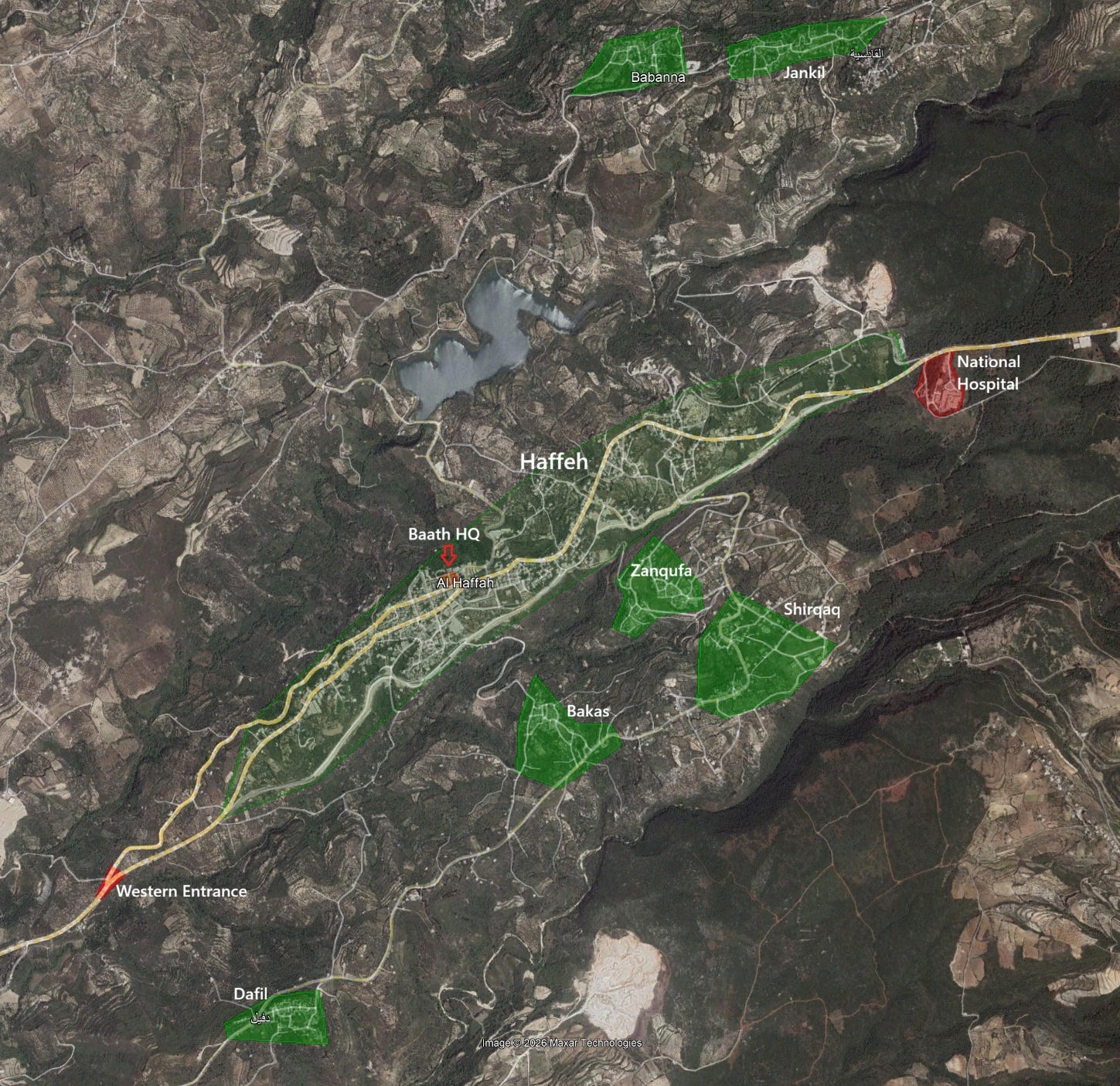
While Liwa Ahrar Sahel began its battles, the revolutionary factions in Haffeh prepared for their own. As was the case with most of the armed opposition at this time, the men here had little experience. A basic plan was decided on and preparations made for about 14 days prior to launching the assault. Regime forces in Haffeh were limited to a few key government buildings and checkpoints, so the fighters were split into three groups advancing from separate axes: one to take the checkpoint at the town’s western entrance, one for the National Hospital at the eastern entrance, and one for the regime headquarters in the center of town.
The battle began in the morning of June 5, though there are conflicting reports on the exact details. According to one local fighter, two security vehicles arrived in the city and clashed with some of the revolutionaries, who then launched their assault on the three positions. One group quickly surrounded the regime security buildings, but as they entered were ambushed by soldiers hiding inside. At least one defector-turned-FSA fighter was killed.
A medical point was quickly established in Babana for the increasing number of wounded fighters. “We had many injured people, but only one doctor with us,” a former field nurse tells me, “So if there was someone seriously injured we had to smuggle them to Turkey, driving at night with no lights for about 1.5 hours between the Alawi villages.” The trip was often too dangerous to take and many injured people died as a result.
By June 6, the western entrance and regime buildings had been captured, but the National Hospital remained under regime control. “The hospital was key to liberate, as it is located on a strategic point above the city, but the regime had heavily armed it and all the villages around it are Alawi,” the field nurse explains, “But we lacked coordination and weren’t powerful, we had no experience using weapons and were young, and most of the defectors were in Turkey or other areas at this time.”
Regime forces began to heavily shell the town and bordering Sunni villages with artillery and mortars over the next week, killing women and children alongside revolutionary fighters. In Bakas, seven young children were killed by shelling in one day alone. Regime forces were attempting to storm the town from the eastern and western axes throughout this period. The Slenfeh road connecting to the National Hospital was a key route for regime units, while other forces advanced along the highway from Latakia city to Haffeh’s western entrance.
Regime militias from the surrounding Alawi villages were also mobilized and heavily involved in the fighting. Reports of regime casualties posted by pro-Assad Facebook pages in the years since have identified members of the Latakia Baath Battalions and National Defense Forces, the later of which was under the command of Bashar al-Assad’s cousin Hilal Assad. Residents of Haffeh also accuse these militias and local shabiha of attacking civilians fleeing Haffeh for the countryside. “Village Popular Committees would stop cars and let some people go, kill some, humiliate others,” two residents tell me, “The people of Haffeh tried to escape to Latakia, but it all depended on your luck.”
Liwa Ahrar Sahel units had just captured most of Salma when the fighting began in Haffeh and the FSA leaders quickly mobilized to aid the besieged people. According to one man, Colonel Malik Kurdi, a Naval officer who had defected a year earlier, sent medical supplies and some fighters to the villages near Haffeh. Lieutenant Colonel Muhamad Hamdou, the commander of Liwa Ahrar Sahel and survivor of the Southern Raml siege, mobilized 200 of his men and sent them south from Salma. On June 8, these units had reached the outskirts of the Haffeh countryside and ambushed some regime units operating on Haffeh’s eastern axis.
Yet a lack of coordination and the strength of regime units prevented the reinforcements from reaching the city. According to two former fighters, personal disputes between one of the group leaders in Haffeh and leaders in Jabal Akrad undermined already weak connections between the two regions. “Our commanders did not get along, there was some personal problem, but even if we had worked well together, we were too weak,” one man tells me.
By June 10 significant regime reinforcements had arrived, including helicopters dropping small bombs and firing machine guns from the air. Rebel positions collapsed on the city’s eastern axis and fighters began withdrawing to the villages. The western entrance persisted for another 24 hours, however, holding off regime forces until tanks and heavy artillery arrived. “After one week we could not fight anymore. Our weapons were breaking and we ran out of supplies and had to flee,” says a former fighter.
On June 11, the final rebel forces and civilians withdrew from the city. Around 90 people were killed while retreating deeper to the mountains, including women and children. Regime forces and local loyalists set fire to much of the forest around Haffeh that day as well. “All we could do was create a corridor for those in Haffeh,” Lt Colonel Hamdou tells me. “We opened the way for 2,000 fighters and civilians to withdraw and join us in Jabal Akrad.” The successful withdraw of so many was a small victory amid the loss of the strategic Sunni town.
On June 12, 2012, regime forces took full control over the town. At least 43 regime fighters were killed during the battle, according to funeral records I have collected. Most significantly, the commander of the regime’s 53rd Special Forces Regiment was killed during the initial liberation of Haffeh on June 5. In total, the battle involved units of the 143rd Brigade, 53rd Regiment, police special tasks units, and Military Intelligence members from the Latakia and Hama branches, all supported by local Alawi militias and the Syrian Air Force. At least 12 policemen were also taken prisoner early in the battle, all of whom were released by the FSA a month later.
According to the historian Qaboura, rumors and misinformation played a large part in the battle’s failure. Fighters overestimated their strength, believing regime forces in the area were significantly smaller than in reality and were misled by false rumors about certain strategic points being liberated. However, according to Qaboura, around 100 fighters remained in the Haffeh countryside. For nearly eight months, these men, operating out of small cells, moved through the steep mountain valleys in the Haffeh region ambushing regime patrols and checkpoints. In early 2013, regime forces uncovered these insurgent bases and began targeting them. The last cells then withdrew to Salma – which by this point had become a major hub of armed revolutionary groups. The final retreat to Salma took 24 hours and resulted in the deaths of two more fighters.
“Just me and the Cats”
Reem had fled Haffeh alongside thousands of other civilians three days after the battle began. Regime snipers were shooting anyone on the streets and artillery was hitting the town and Sunni villages. But she could not stay away from her city for long, and in early July returned to find Haffeh still empty and destroyed. Reem was one of the first people to return to the city, “It was just me and the cats living here,” she tells me. Even one month after the battle she was still overwhelmed by the smell of blood and guns in the air.
Regime forces had looted and burned down shops across the city when they entered in June. A U.N. delegation arrived on June 14, its members later quoted describing a, “strong stench of dead bodies” upon their arrival. One UN member filmed part of their drive through the town, showing street after street of damaged buildings and still-burning shops.
While the fighting inside Haffeh had ended, the Sunni villages around the city continued to be shelled and attacked for months. “There were still some armed groups in Barqas and Darfil and the regime assaulted the villages around September 2012,” says Qabarou, “When they entered the villages they were already emptied, most of their martyrs had been killed on the road to Latakia during the June battle and the survivors had gone to Turkey.” Olive groves were burned down and the villages gradually destroyed through shelling and looting as their residents became entirely displaced. In December 2012, regime security forces conducted a mass arrest campaign of every man accused of supporting the FSA, according to Reem.
The suffering of Sunni families in the Haffeh region continued into 2013. Some families gradually returned to Haffeh that year as they ran out of money to rent apartments in Latakia, but often found their farmland had been seized by the regime. Others were able to still work their land but had to pay bribes at the new checkpoints while bringing their crops to market. Men continued to disappear while traveling the roads around Haffeh, often believed to have been kidnapped at militia checkpoints outside Alawi villages. Army checkpoints also detained men for forced conscription. As a result, Haffeh was empty of young men by 2015 – either detained or fled.
In August 2013, Alawi militias from nearby villages stormed the isolated Sunni village of Qashbah and executed more than 30 members of the al-Fatih family, including women and children. Some men of the family had joined the Free Syrian Army in Haffeh the year prior and were now fighting in northern Latakia, but the village itself was unarmed and uninvolved. Fifteen former regime militiamen accused of participating in the massacre were arrested by the new Syrian government in March 2026.
The battle for Haffeh is a foundational event for the region’s Sunni population. It was a major strategic defeat for the opposition, cutting off access to much of the governorate and handing the regime an important foothold in the mountains. The brutality of the regime’s response and extensive involvement of local militias also left deep scars in these communities. This small Sunni enclave lost hundreds of civilian and revolutionary martyrs to the war, and many families returned to their villages after 13 years of displacement to found their homes looted or destroyed.
The role of militias from neighboring Alawi villages left the deepest impact. “Before the battle there had been friendship between the sects,” says Reem, “but there was a harmful relationship afterwards.” When asked if he differentiates between the crimes of the army and the militias, one resident responded flatly, “The militias, the militias were the worst.”