

“I want to show you this live feed of the graves of the bastards of Khan al-Subul,” Muhammad al-Sarhan pans his phone around him as he speaks, revealing a small graveyard, “I will go back for you all, I promise with my honor that I will go back for the dead before the living.” A few days later, al-Sarhan published a new video on Facebook of himself and a small group of men crowding around one of the graves. “Abu Kamal,” he says into the camera, referring to the man buried beneath his feet, “I promised you I would take revenge, and now you’ve got it.” The men break the tombstone and begin to exhume the body.
Abu Kamal was a famous revolutionary from Khan al-Subul, a small Sunni town on the edge of Syria’s northwestern Idlib governorate. Muhammad al-Sarhan and the other men participating in the desecration of Abu Kamal’s grave had been his neighbors. While Abu Kamal died fighting against the Assad regime, the others had chosen to fight for Assad at the outset of Syria’s revolution in 2011. In late January 2020, regime forces captured the town, allowing al-Sarhan and the others to return home and enact the revenge they had been planning for years.
The videos reflect the often-irreconcilable fissures that have emerged between revolutionaries and loyalists in every town across the country since 2011. Revolutionary vs loyalist dynamics in Syria have long been misunderstood. Some claim that, although Bashar al-Assad and his family are Alawi, it was Sunnis who ran the country, while others claim the entire regime was run by members of the Alawi sect. The truth is much more complicated and the dividing lines ran through sects, ethnic groups, tribes, families, and cities.
The Assad regime’s military and intelligence apparatus were dominated by career Alawi officers, while economic power remained in the hands of many prominent, loyalist Sunni families with some key sectors controlled by the extended Assad clan. On the street level, the regime relied on huge numbers of Sunni informants and thugs to help police their communities. Sunni loyalists, whether informants, thugs, or businessmen, were all tied to the regime through ideological adherence to the Baath Party or, more commonly, by leveraging personal privileges, money, access to key state brokers, or playing on internal Sunni divides.
The sectarian legacies of the Assad regime and crimes during the revolution have clouded outsiders’ understandings of transitional justice in Syria today. “The Sunnis do not care about their own shabiha,” is a common accusation leveled by minorities and activists who feel there is too much pressure on non-Sunni communities to hold their criminals accountable. Yet, many revolutionary Sunnis across the country will readily admit in private that it is the Assad loyalists from their own towns who they reserve the most hatred for. As a result, many Sunni regime collaborators have been expelled from their towns or killed, both during and after the revolution.
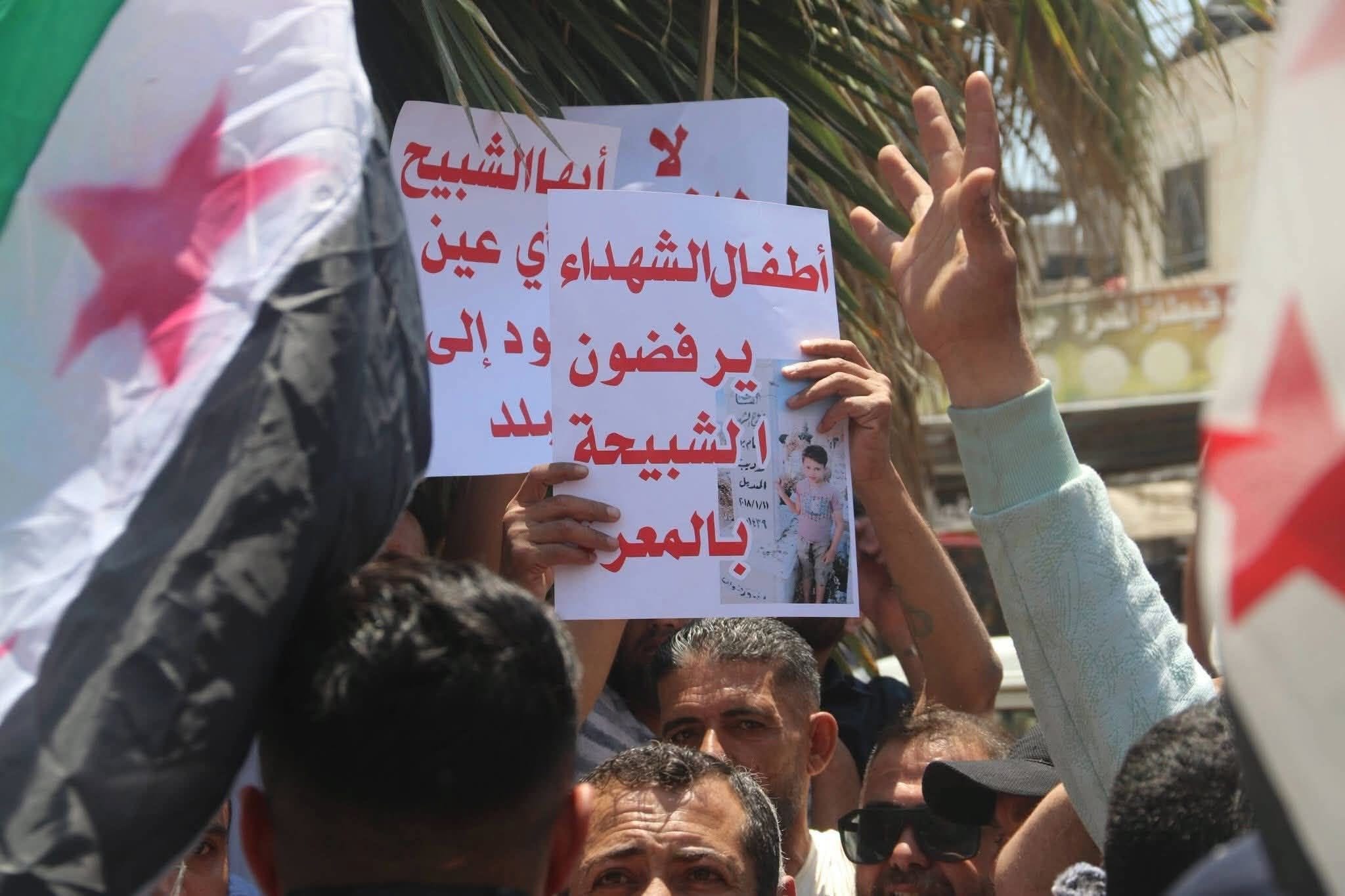
The communal cleavages wrought by these betrayals have not eased with the country’s liberation. On June 13, 2026, thousands of protestors took to the streets across the country denouncing the shabiha and categorically rejecting their return to the towns. In northwest Syria these demands were explicitly directed towards local Sunnis. Across Idlib, daytime marches and demonstrations gave way at night to mob attacks against the homes of alleged shabiha. At least two men accused of being regime informants were beaten to death by the crowds. Idlib governorate exemplifies the degree of accountability revolutionary Sunnis are holding against their own. In every town, and from every resident, the same matter of fact statement can be heard: “If the shabiha return, we will kill them.”
The Informants
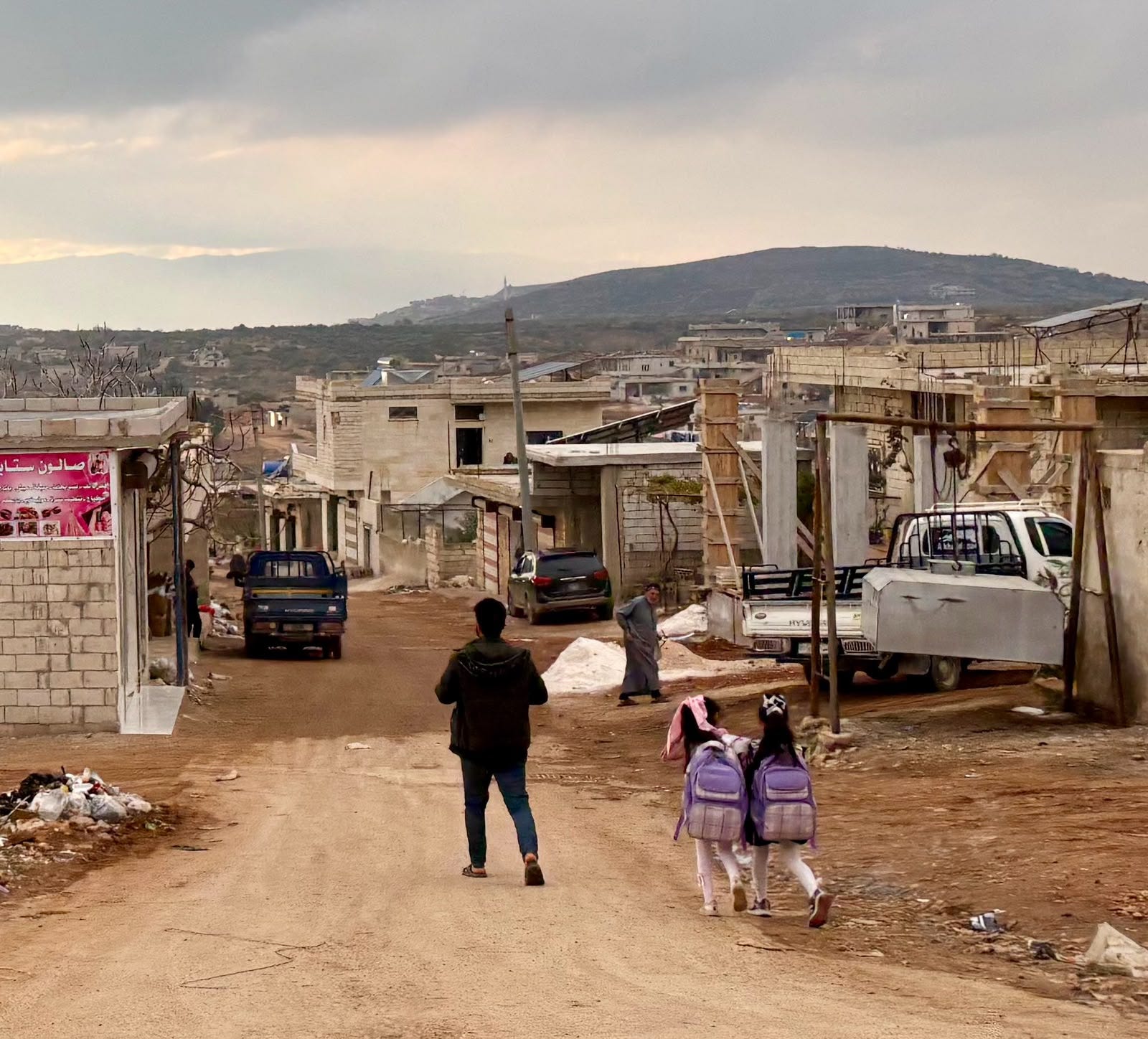
It is late 2025 and I am driving around the mountains of southern Idlib with a young former Jabhat al-Nusra fighter. We are touring the villages of Jabal Zawiyah where he was born and spent a decade fighting, places I had spent many years studying from afar. “There were shabiha in every town,” he tells me as we drive through yet another street of destroyed homes. Towns which would later become household names for their revolutionaries and martyrs were, at the same time, haunted by their own. Their numbers and motivations differed, but all caused immense, personal damage to their communities. For Idlib’s towns to liberate themselves from the regime, they had to first confront their traitors.
Many of Idlib’s shabiha began their careers as informants. These men played important roles in supporting regime operations after 2011 and as the first step in the long chain of individuals responsible for the mass detentions and disappearances of hundreds of thousands of Syrians throughout the war.
During the summer of 2011, the Assad regime deployed a half dozen military regiments and brigades across Idlib, establishing hundreds of checkpoints and bases along all major roads. These positions were staffed by soldiers and intelligence officers, but also supported by local informants. These men, and at times women, provided regime forces with invaluable information on protest organizers and revolutionary leaders who were then detained in raids or whose houses would be shelled. Yet they are also widely accused of using their power to exact personal revenge against their neighbors.
In every town, you can find a story of a man, woman or child gunned down by nearby checkpoints simply because of a personal dispute with the local informant. In Saraqib, for example, a man from a nearby town named Abu Yassin worked at one of the city’s main checkpoints providing information to the soldiers there on civilians in the area. In one case, Abu Yassin is believed to have accused a local man of working with the armed opposition, resulting in soldier gunning him down as he drove by the checkpoint one day. The man had been an uninvolved civilian who had a dispute with Abu Yassin from before the revolution.
The Fighters
While some shabiha remained as informants, others quickly crossed the line into direct fighting. As in the more well-known places like Homs and Aleppo, the regime attempted to organize Idlib’s shabiha networks into formal militias as the revolution turned into full-scale war. Moving from informal networks to militias relied on the existence of strong local personalities who could be tapped to lead, and on a strong enough presence of shabiha to form coherent fighting groups.
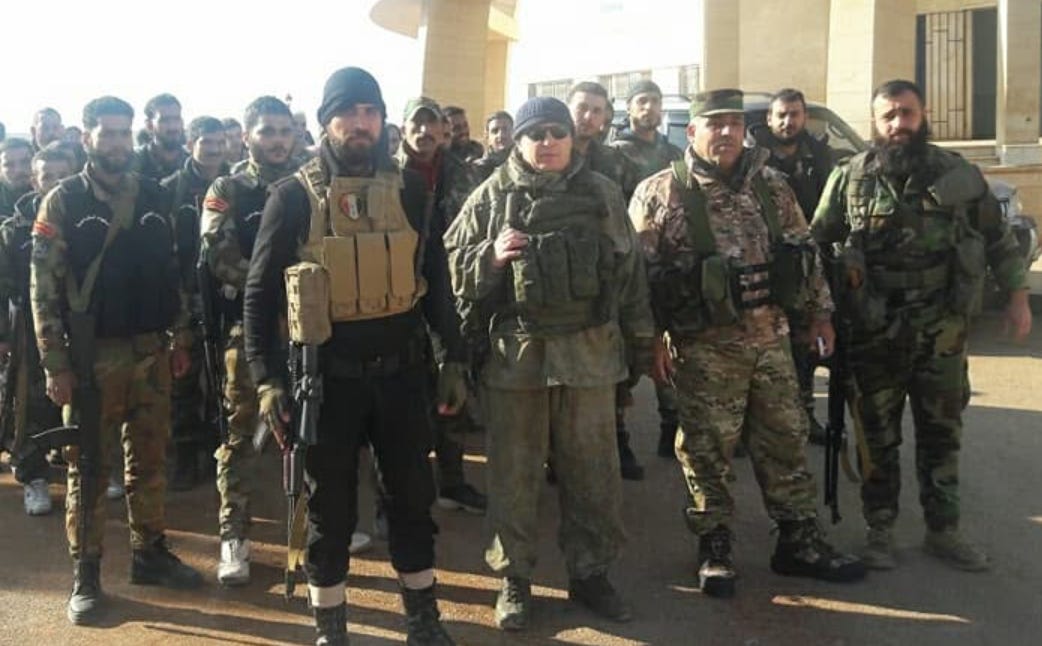
Al-Sarhan was part of one such group of Sunni loyalists from Idlib, many of whom viewed the 2019 offensive against the governorate as an opportunity for revenge. His militia, known as the Idlib Special Tasks Battalion, was trained and commanded by Alawi officers from the Republican Guard, but led on the ground by Alaa Din Barhoum. Barhoum was a life-long shabiha from Kafr Battikh, a small Sunni town just north of Khan al-Subul.
Complaints against Barhoum go back decades; in one case, a young father spent a year in the infamous Palestine Branch prison in 1995 after Barhoum overheard him cursing Hafez Assad and informed the local intelligence branch. When the revolution began in 2011, Barhoum and nine other informants in the town initially kept a steady watch, reporting on every protest and potentially disloyal family to their mukhabarat handlers. However, Kafr Battikh’s revolutionaries quickly grew in power and forced a reckoning on the shabiha: abandon your ways and confine yourselves to your homes or face justice. Eight informants agreed, Barhoum and another man fled to regime strongholds.
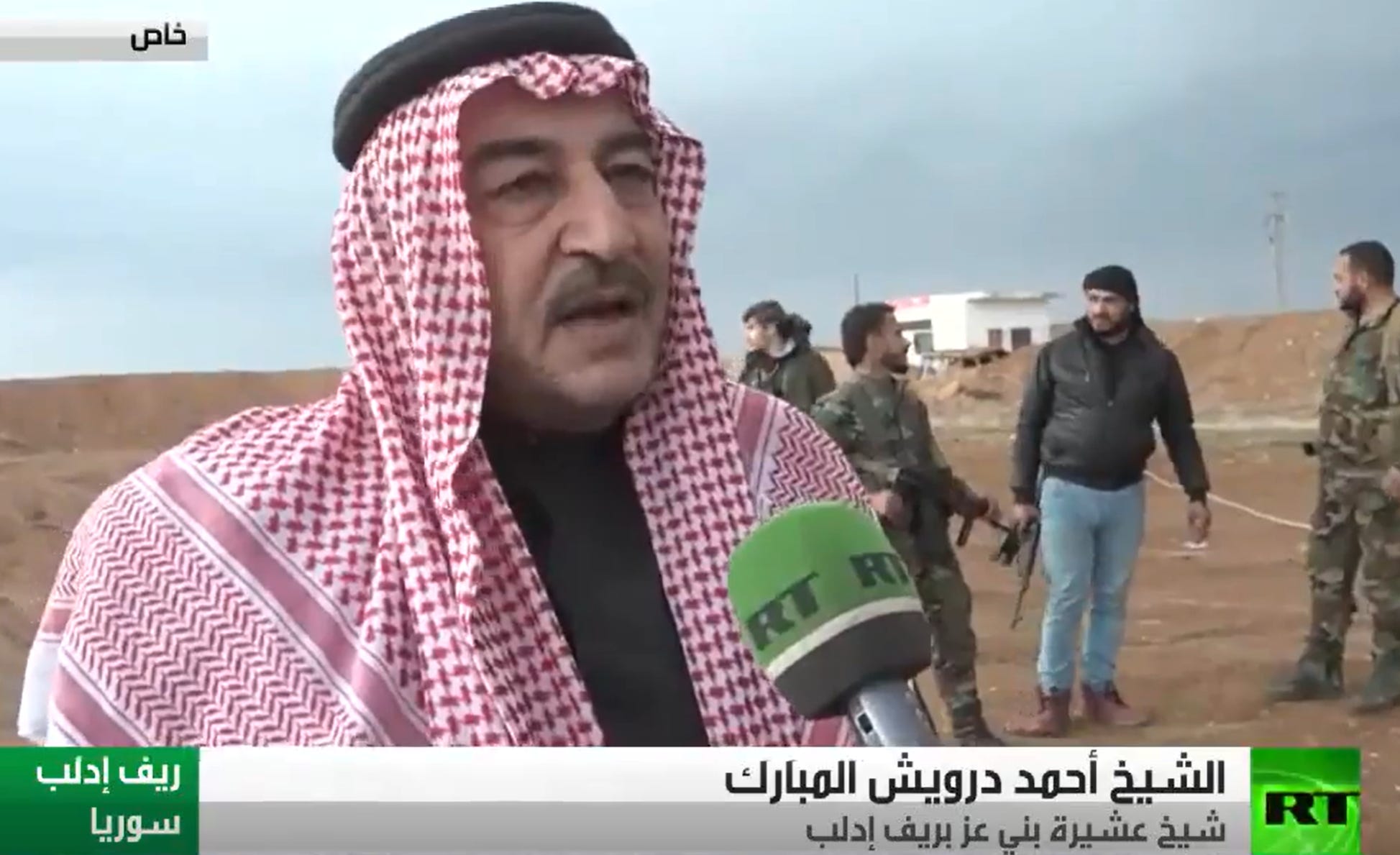
These power struggles between the shabiha and revolutionaries played out across Idlib in 2011. In Maarat al-Numan, for example, the early protests were frequently met with attacks by local pro-regime thugs organized by the area’s People’s Assembly representative, Sheikh Ahmed Darwish al-Mubarak. Mubarak was a Sunni tribal leader from the villages east of Maarat who personally participated in attacks against protesters in the city, according to one of the city’s organizers.
Yet Maarat al-Numan was quickly becoming a center of the opposition’s civil and armed movement in southern Idlib, and most of the city’s shabiha gave up within a few months. Outnumbered in Maarat, Mubarak returned to his hometown in the countryside and established a pro-regime militia from among his loyal tribesmen, which went on to participate in battles across Idlib and Hama until it was crushed by opposition fighters in 2018.
Much of the regime’s loyalist mobilization in Idlib relied on members of the ruling Baath Party like Ahmed al-Mubarak. The party had long served as a key tool for coopting Sunnis into the regime, and many of the loyalists mobilized after the start of protests, as opposed to the long-time informants, were affiliated with local Baath branches. One of the few regime militias to form in southern Idlib’s Jabal Zawiya region, for example, originated from two Baathist brothers in the town of Ehsam.
Osama Fadl was the school district director, his brother, Mustafa, a retired army colonel. According to a series of biographies published during the war by his supporters, Osama was tasked by the Idlib Baath Party to organize local loyalists into a fighting group in July 2011, with Mustafa assigned to lead the group’s military operations. They fought across more than a dozen towns in Idlib and Aleppo in the ensuing years. Mustafa would die in battle, while Osama was promoted through the Baath-affiliated militia sector in Idlib and was eventually appointed as the Secretary of the Baath Party Idlib Branch by 2021.
The Hardliners
Baathist loyalty was not the only motivating factor for Idlib’s shabiha. Personal motivations for working with the Assad regime often reflected each town’s unique social dynamics. Even a weak informant network caused immense harm to civilians and the revolution, but eventually succumbed to local revolutionaries. However, some towns had much more robust, and brutal, loyalist movements that proved harder to dislodge.
In the far northwest corner of Idlib, on a mountain slope overlooking the Turkish border, sits the towns of Salqin and Harem. Ask any revolutionary from the region about them and they will tell you: “those towns were full of shabiha.” Overstretched regime forces relied on hundreds of local fighters to first attack demonstrators in 2011, and then to support the full occupation of the towns in 2012.
“You had many weak minded people, especially youth, who could be bought,” one former activist tells me. Money and power were a strong motivating factor, but in Salqin, these networks were strengthened by the town’s role as a major trade hub. “Many here worked extensively in Aleppo, so you have entire families of shabiha,” explains one resident, “But we did not use this term early on, we referred to them as ‘having business with the security.’” Many traders working across major cities naturally developed relations with the regime’s security apparatus in order to facilitate their work. When the 2011 protests began, the regime leveraged these relationships to mobilize strong loyalist movements inside Salqin, betting on local families’ desires to maintain their financial positions.
By mid-2012 the regime had heavily armed these groups. “I knew a car mechanic who joined the shabiha early on,” one resident tells me, “I warned him to stay away from the regime, but he insisted, ‘No, I am just using them for the money and guns and alcohol.’ But later he and his siblings became full shabiha.” The men would be captured later in 2012 when their base came under attack and all three were executed by local revolutionaries for their crimes.
The shabiha networks in nearby Harim were similarly strong, but as a result of a distinct local dynamic rooted decades prior. “The reason for the shabiha is not the revolution itself,” a local activist tells me. Unlike Salqin, Harim’s families relied on huge expanses of farmland for income. The Baathist land redistribution policies on the 1970s resulted in the seizure of most farmland owned by the Ottoman-era families in the town and the importation of new Sunni residents from other parts of the country. These new families were given the seized land and homes in Harim’s two oldest neighborhoods; their fates became inseparably linked to the regime’s as a result.
“The biggest damage to the revolutionaries here was not by the army, but by the shabiha who owned the stolen lands,” the resident tells me. “They had been given life by the Assads and were loyal to them until death. Our revolution was against Bashar Assad, not against the shabiha families, but they turned it against us and became their own regime.” Hundreds of loyalists were given arms and were soon organized under the direct command of Idlib’s Military Intelligence chief. Locals who wanted to join the opposition had to leave Harim for the mountains, but the shabiha knew each of their names and families and would often burn down their homes as punishment. Once in 2012, local shabiha exhumed and desecrated the recently buried body of a resident killed fighting regime forces elsewhere in Idlib.
“Any crime committed in other parts of the country can be found here,” a resident tells me. In one example, the son of a shabiha family joined the demonstrations and was killed by security forces. Instead of burying him, his father, a prominent shabiha, drug his son’s body through the city streets. “The shabiha here are not ones of opinion, like ‘I support Assad,’” the man continues, “They are shabiha whose hands are filled with blood.”
The battles to liberate Salqin and Harim took four months, in large part due to the size and strength of the towns’ loyalist fighters. In the final weeks, the shabiha and remaining army units had withdrawn to Harim’s ancient hilltop castle. On the morning of December 23, 2012, 160 shabiha awoke to find the army and wealthy loyalist families had retreated to regime-held Idlib city. The abandoned loyalists ran to the mountains where they began stealing from shepherds until units of the Free Syrian Army caught them. All but one were executed. Those loyalist families who had surrendered inside the city were given safe passage to regime-held lines, where many men continued to fight for the regime until the end of the war, or death.
The Free Syrian Army coordinates with the Red Crescent to evacuate families of regime shabiha from Harem to Idlib city, December 2012. Note the presence of what seems to be an IRGC officer representing the regime.
An Incomplete Justice
The last towns in Idlib governorate were liberated in 2015. The most hardcore loyalists continued to fight under a variety of regime militias throughout these battles: the National Defense Forces, Baath Battalions, the Special Tasks Battalion, and Popular Committees were all systems through which the regime mobilized and managed its local Sunni loyalists during its retreat from the governorate, and again in 2019 during its offensive to recapture the area. Most loyalist families consequently fled to regime-held areas in Aleppo or the coast for most of the war, but their names and crimes were never forgotten.
The sudden collapse of the Assad regime in December 2024 opened a door to justice that many Sunnis had long thought was closed. Justice and revenge began swiftly. On December 13, 2024, just five days after the regime fell, dozens of people gathered in Khan al-Subul to watch and cheer as Muhamad al-Sarhan was marched through the street to an awaiting security vehicle. In nearby Kafr Battikh, Alaa Din Barhoum quickly fled to Lebanon, knowing what fate awaited him as the town’s displaced residents came back. One resident put it plainly to me a year later, “If he returns, we will kill him.”
From Aleppo to Damascus, vigilante killings became a near weekly occurrence. Almost all of them targeted former Sunni informants, collaborators, intelligence members, and militiamen. Many families who had left Idlib for regime areas during the war were hesitant to return to their towns, as any Sunni who had fled to the regime, rather than away from it, now came under intense scrutiny. The term fulul, meaning “remnant”, has become a ubiquitous part of hate speech directed towards minorities online. Yet it is just as, if not more, commonly used among the Sunni street to describe any Sunni who remained under regime control.
While some shabiha have been arrested and others killed, there remains immense unresolved anger and demands for justice in Idlib. The June 2026 protests were triggered by different factors in each region: in Damascus they took on a sectarian angle, in Aleppo it was rooted in inner-Sunni political disputes, but in Idlib it was an expression of absolute rejection of the governorate’s shabiha who had begun to return.
Revolutionary credibility has become the preeminent social capital of the Sunni street. Anyone who stood aside, or is believed to have abandoned the revolution early on, is open to suspicion. Those who actively worked with the regime are widely rejected. The collaboration of non-Sunnis with the Assad regime is viewed almost as an expected outcome of the regime’s sectarian and political manipulations of Syrian society, while Sunni collaboration was a betrayal of family, sect, and revolution. As one researcher in Homs explained to me this summer, “We prioritize dealing with the Sunni shabiha before the Alawi shabiha, because the Sunni shabiha did the biggest damage to our revolution.” I heard near identical sentiments from former revolutionaries across Idlib over the past year.
This priority is reflected in the narratives many of Idlib’s revolutionaries share about the war. The town of Muhambal for example, suffered for four years under killings, detentions, and bombardment from a nearby regime base. When asked about the forces responsible for these killings, some younger residents made sweeping sectarian statements, “They were all Alawis.” But older revolutionaries spoke specifically about the Sunni general from a nearby village who commanded the checkpoint. His officers may have been Alawi, but it was this Sunni man from the area who oversaw the killings and indiscriminate destruction of homes and farmland. Several of his relatives were killed during the war in retaliation for his crimes. Today he is suspected of hiding in Suwayda, outside of the government’s reach.
The people of Idlib suffered under dozens of chemical weapons attacks, systematic hospital bombing campaigns, massacres from artillery and barrel bombs, and widespread displacement and looting of their homes. Yet, as across many Syrian communities, it is the particularly brutal and personal nature of the shabihas’ crimes that remain at the forefront for so many. These men and their families are not accepted back in Idlib – even those who were with the revolution but share the same family name as famous criminals face some harassment today from people who know only the crimes of their relatives.
“This is the most complex subject in Idlib because you have families divided between the two sides,” one resident tells me. Communities who suffered under decades of crimes are struggling to determine where accountability ends and reconciliation begins. Is an entire family guilty for the crimes of one man? Most outward transitional justice discourse focuses on this question as applied to the Alawi community, but it is being asked on a daily basis for Sunnis as well. “Right now, we are living through this situation where a revolutionary brother says yes my brother was shabiha but his children are innocent.” Government-backed Reconciliation Councils attempt to mediate some of these intra-communal and intra-family divisions, but reconciliation and forgiveness are hard to sell to those who survived decades of crimes.
In Idlib, as in many close-knit communities across Syria, those men who participated in spilling Syrian blood are known by the neighbors. These criminals, considered to be the proven guilty by their towns, are resolutely rejected. “As a government the policy is known, they try to bring people together to reconcile and those with blood on their hands will be handled by law,” a former rebel commander tells me earlier this year, “But as people, certain things cannot be forgiven, the killings and massacres. Here there were several massacres, and those who fled know that if they come back, they will be killed immediately.”